
You have an order in production and an AQL inspection to book before the goods are packed. Inside that request the sampling plan is the easy half, and it is the half everyone discusses. What decides whether the check can release your goods is the other half: how many of the references the inspector will judge against are already closed in writing, by you and by us.
Two of our own model records show the problem in miniature, and it is not a defect in the goods. This page is the starting point for the subject — what an inspection of an appliance order can decide, what it needs before it can decide anything, and what to do with the references still open on your file.
What does an AQL inspection actually decide?
It decides one thing: whether a defined lot is accepted or rejected against a fixed set of checks and limits. AQL is the limit that indexes an acceptance-sampling plan — one value set for each defect class — and the plan built around it is what turns a sample into a pass or a fail. In the standards these plans are usually written to, ISO 2859-1 and ANSI/ASQ Z1.4 in the consumer-goods trade, the lot size and the inspection level give the sample size, while the AQL value for each defect class gives the acceptance and rejection numbers. Those decisions belong in your order instruction; writing "AQL inspection" on a purchase order does not create them.
The inspection level is the part buyers change most often. The general levels I, II and III give increasing sample sizes for the same lot, with level II the usual default for consumer goods, and the special levels S-1 to S-4 give much smaller samples for checks that are slow or that destroy the unit. Changing the level changes how many units are checked, not the AQL itself: the acceptance and rejection numbers are read against the sample size that level produces, and the lot is accepted only while the count in each defect class stays at or below its acceptance number.
What the result is not: a defect rate for the whole order, or an estimate of how many units in the container will fail in a customer's hands. It is a lot-acceptance decision, taken on a sample, against the references written into the instruction.
And the sample cannot tell the inspector what the goods were supposed to be. That has to come from five places before anybody arrives: the exact model suffix and its rated values, the approved sample and configuration, the packing version, the documents that cover your model and destination market, and the quantity of each version in the lot.
It is why the request we make of buyers is not a defect percentage but the inspection plan and the records behind it, for the selected model, configuration and destination market. A report produced without them is accurate about the units and silent about the order, and the argument that follows happens once the pallets are wrapped — when the only options left are a concession, a rework or a reinspection.
Which references have to be settled first?
Five at minimum, and each has a written form: an order confirmation line, an approved sample record, a packing specification, a document number, a quantity breakdown. A reference is settled when both sides can point at the same sentence.
The model line is where most of it starts, and a family table is less forgiving than it looks. Take two coolers from our air cooler range: the WJD4500F-1D is recorded at 75 W with six speed settings on a 24 V DC supply, while the WJD4500F-1Z is recorded at 125 W with three settings, and its page states that voltage and frequency are not specified there at all. Both carry a 42 L tank, the same 500 × 410 × 960 mm product dimensions, the same 12.6 kg net weight, and the same 550 × 460 × 1,020 mm carton at 14.6 kg gross.
An inspector standing in front of the carton cannot tell the two apart, and neither can a check written at family level. What separates them is the label and the rating, so the order line has to name the suffix and the rated power, and the inspection instruction has to repeat both. Where a record itself leaves the supply open — the -1Z above, and the 200 W WJD8000F-1M, whose record also lists no voltage or frequency — no amount of looking at the goods closes the line. It closes when the rating for your order is confirmed in writing.
We have done this kind of correction on our own copy: three cooler models were restated from 6 L to 5.5 L so that older capacity claims could be reconciled before order specifications and packaging were approved (how the capacity correction was handled).
How are findings sorted and counted?
Before a finding can be counted it has to be classified, and the classification has to be written for your product and market rather than borrowed from a generic list. In the trade the three classes are critical, for a finding that breaks a mandatory requirement or creates a safety risk; major, for one that stops the unit working or being sold as it stands; and minor, for a deviation that leaves it usable.
For an appliance order the list usually comes out like this. Critical covers a nameplate carrying the wrong rated voltage, a missing mandatory label, or a live part left reachable. Major covers a unit that runs but will not reach its low speed, a plug that does not match the market, or a carton marked with another suffix. Minor covers a scratched housing or a smudged print. Your list will differ by model and destination — which is exactly why it is written down before the visit and not argued afterwards.
Three counting rules then decide what the numbers mean:
- Draw the sample across the lot. Units from different carton positions and production runs, not the first stack by the door, so one prepared carton cannot stand in for the order.
- Separate the checks that share the sample. Visual and packing checks usually run on the whole sample; a function test may run on a stated subset; a destructive test on fewer units again. Each subset is reported against the quantity actually tested, so a check completed on ten of fifty units is not fifty passes.
- Say whether you count findings or units. One unit can carry several confirmed problems. A report that mixes the two produces a percentage nobody can act on, and the counting rule should be fixed before the result is known.
Where does each check sit, and what can it still change?
Four positions, four different kinds of correction. Before production, everything is still open: model, rating, sample, artwork, packing. While the line is running, a deviation can still be put right at the station that caused it instead of being sorted out of a finished pallet, and that is the difference between a correction and a sort.
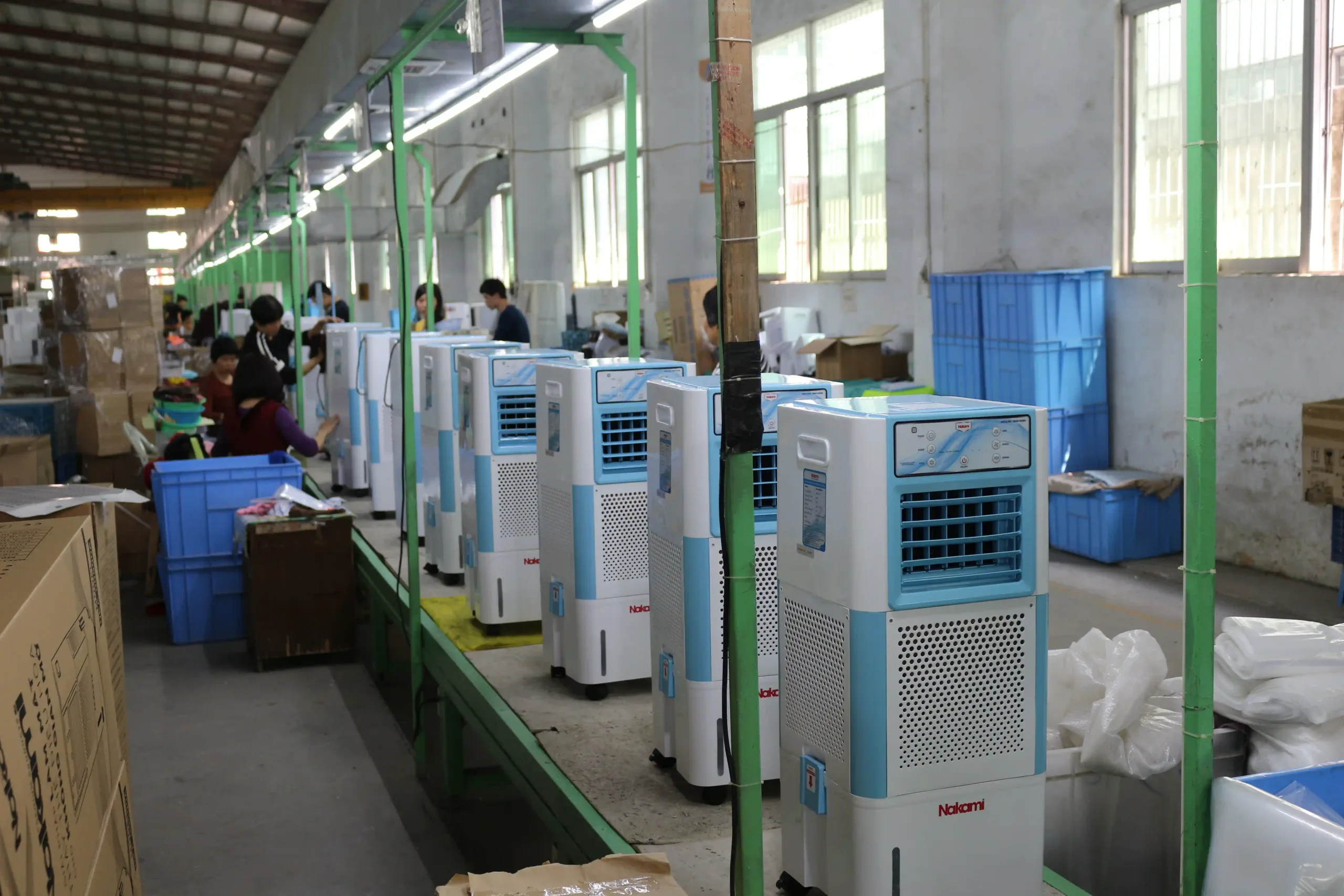
Before packing closes, the check sees the unit as it will ship, which is not always how it was approved: the 8,000 m³/h model is packed with the tank inverted, into a 695 × 460 × 980 mm carton at 21 kg gross. A unit checked standing upright on a bench has not yet been checked as it travels.
At loading, the question narrows to identity: carton marks, the count of each version, and whether the cartons going in are the ones the report describes. That is a different question from whether the product is good, and it is the last point at which an error of identity can still be stopped.
How do you read a document's scope before you rely on it?
Read four things, in this order: the model list, the rated values, the report the attestation refers to, then the date. Treat the title as the least informative part. Our About page publishes 14 records with their scopes, and it says there that each record has its own product and model scope, and that an issue date is a document date, not a claim of current approval for the whole range.
The limits look like this on the records themselves:
- CB test certificate CN61410, issued by the China Quality Certification Centre on 19 September 2023, names WJD8050A/B/C/D, WJD8060A/B and WJD8080A/B. If the order is a cooler, that list is not about your goods, whatever the certificate's own title suggests.
- CE–EMC HK2302060218E and CE–LVD HK2302060063S, issued by Shenzhen HUAK Testing Technology on 15 February 2023, cover WJD8000F-2Z, WJD8000F-1Z, WJD8000F-1M and other listed models at tested-sample scope, and each points to its report — HK2302060218-1ER and HK2302060063-SR. The attestation is the summary; the report is the record.
- CB test certificate CN42744-M2, issued by the China Quality Certification Centre on 20 February 2019, is a 125 W, 220–240 V, 50–60 Hz cooler record whose model appendix is not included in the scan. Until that appendix arrives, the number establishes that a record exists, not which suffix it covers.
- CCC 2019010702183023 is an English reference translation with a stated validity from 18 January 2024 to 17 January 2029, and the scan itself says the translation has no legal validity.
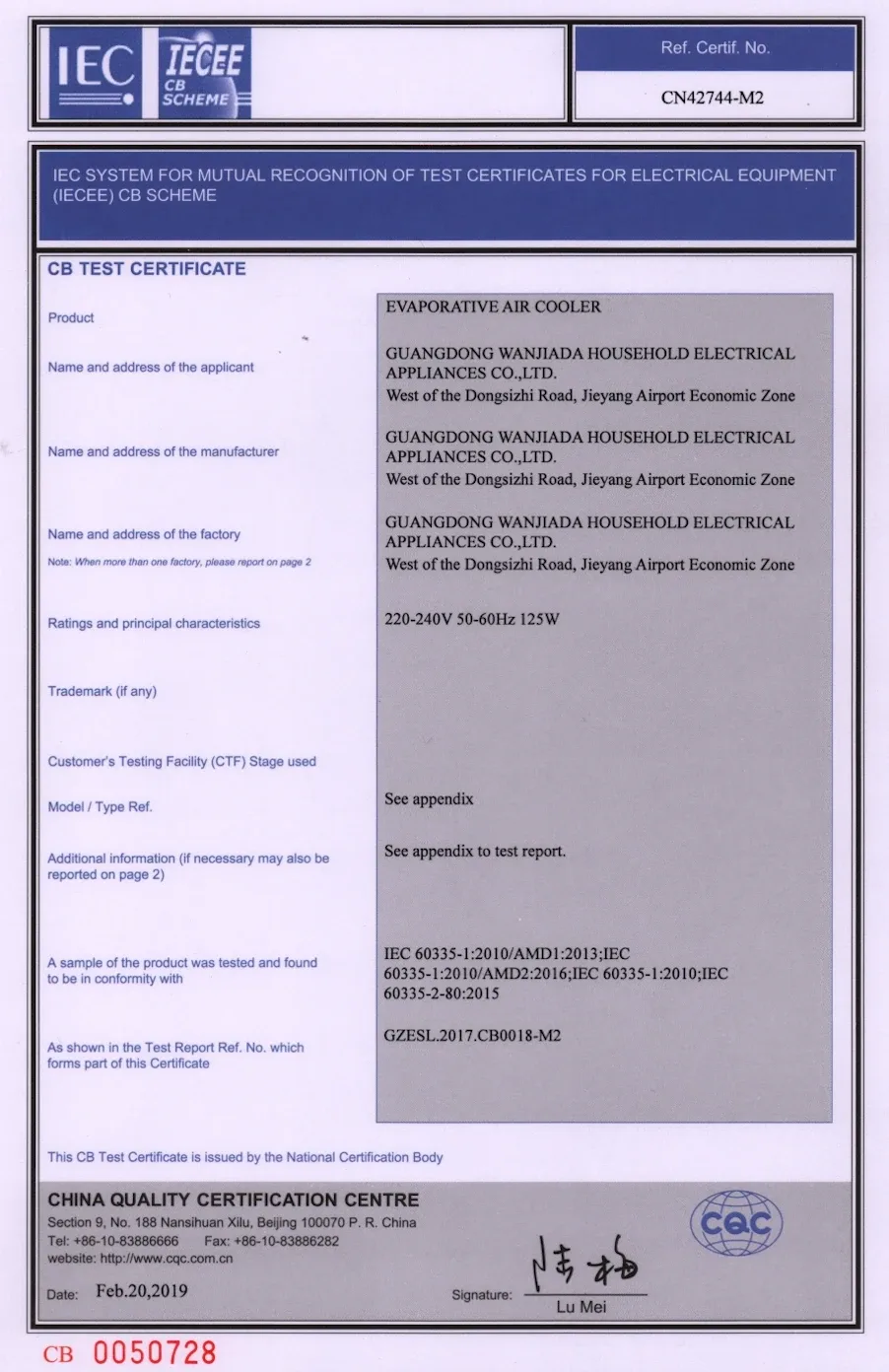
Each of these records stops somewhere, and the useful question is where. A record that stops short of your suffix is not your evidence, and the check that needs it stays open until the record reaching your model is supplied. Which document a market accepts is set by that market rather than by us, so the destination belongs on the order line beside the model.
What does an open line do to a release?
It holds the release. Not pass, not fail — hold, until the line is closed in writing. Four kinds are worth listing:
- A rating the record does not state. It closes when the order confirmation gives the voltage, frequency and plug for that suffix.
- A document whose model list or appendix does not reach your suffix. It closes when the record that does, or the named appendix or report, is in your file.
- A translation standing in for a certificate. It closes when the original-language document and its current status are in the file.
- A packing configuration changed after the approved sample — another carton, inverted instead of upright, new marks. It closes when the packed configuration is re-agreed on the order line and the sample matches it.
Why hold rather than note? Because a report that records a rating check as passed against a rating nobody specified is worse than no report at all. The file then says someone verified it, and the person who has to defend that file months later is you, not the inspector.
The other half of that paragraph is written before the visit rather than after: what you will do if the lot fails. The instruction should name the responses available — holding the shipment, sorting the affected cartons, reworking, correcting the packing, reinspecting — and the person at your end who approves a deviation or signs the release. A report that ends without a disposition leaves that decision to whoever happens to be in the room.
What should you send, and where does the file start?
Send the model and its suffix first, then the order line you intend to confirm — rating, destination market, quantity per version — then whatever you already hold on sample, packing and documents. From there the inspection instruction can be written against references that exist, and the release decision has something to attach to.
If one of those lines is still open on the model you are ordering, we would rather close it with you before production than explain it to an inspector afterwards. That conversation starts with the model and the market (send a model and market inquiry).