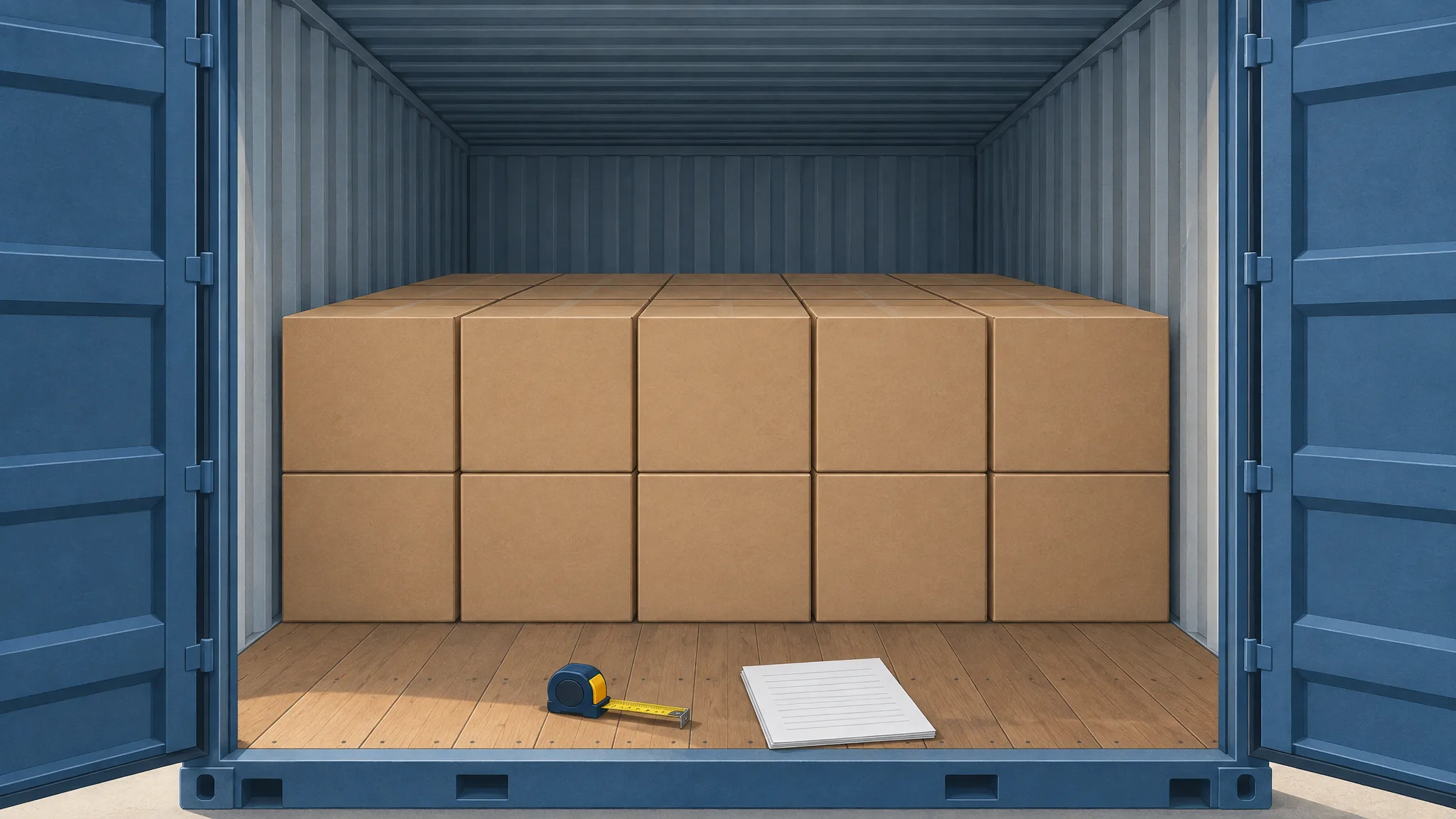
An empty 40ft high cube is 76.2 m³ of air, and a cooler order never fills it. It is worth knowing why before the cartons are booked rather than after: 40ft container capacity is not one figure you look up. It is the smallest of several limits, and on our models the carton decides which of them binds first.
This page is where our container loading subject starts — the limits a cartonised appliance order meets, the arithmetic run on two of our published cartons, and what we can confirm before your goods exist.
What does 40ft container capacity mean for a cooler order?
It means the count you can actually load, and that count is the smallest of four limits: the floor the cartons stand on, the tiers the container's height allows, the cargo weight the container may carry, and how high the carton itself can be stacked. Whichever runs out first sets the answer.
The container's own figures come first, because they are the easiest to get wrong. The sheet we check against, published by Containify, an Australian container company, gives a 40ft high cube an internal length of 12.00 m, an internal width of 2.29 m and an internal height of 2.66 m; a door opening 2.34 m wide by 2.58 m high; 76.2 m³ of cubic capacity; a tare of 3,900 kg; and a maximum cargo weight of 26,580 kg (Shipping Container Dimensions).
Two notes on using those numbers. Internal width and height vary a little between container builders and operators, so substitute your carrier's or forwarder's figures — the method below does not change, the counts do. And cubic capacity is nominal volume, not usable volume: nobody loads 76.2 m³ of cartons, which is what the rest of this page is about.
Why does the carton, not the model, decide the count?
Because the floor is a grid, and a carton either divides it or wastes it. Two models from our air cooler range show it, and neither is unusual for us.
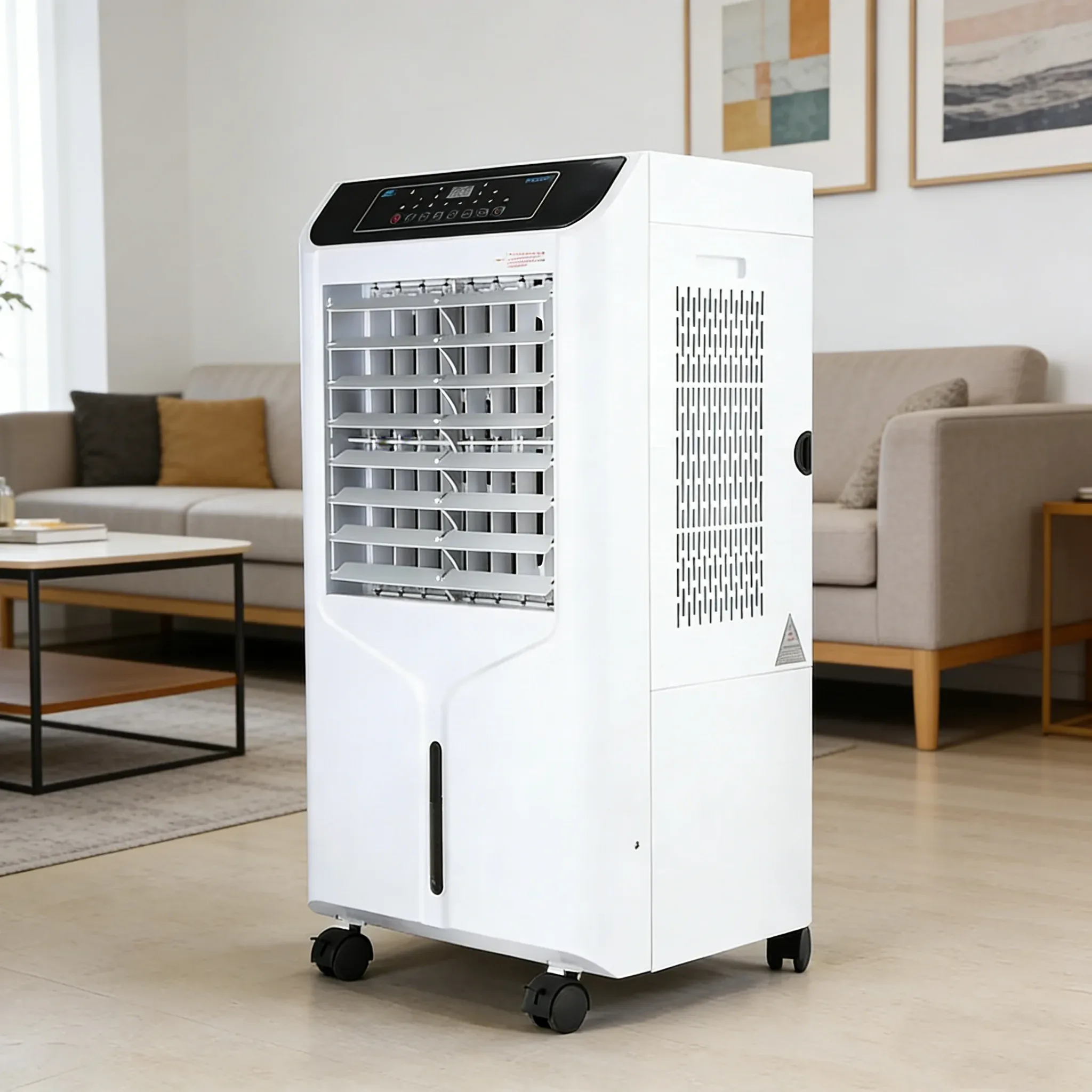
The 42 L WJD4500F-1D measures 500 × 410 × 960 mm as a product and 550 × 460 × 1,020 mm as a carton at 14.6 kg gross, which is 0.258 m³. The 80 L WJD8000F-1M is 680 × 410 × 1,250 mm assembled and travels with its tank inverted in a 695 × 460 × 980 mm carton at 21 kg gross, which is 0.313 m³.
Set the 42 L carton with its 460 mm side along the container's length and 26 fit in a row, using 11.96 m of the 12.00 m; four rows of 550 mm fit across the 2.29 m width with 90 mm to spare. That is 104 cartons on the floor. The 80 L carton also runs 26 to a row, but only three rows of 695 mm fit across, leaving 205 mm — 78 on the floor.
Two tiers of each give the figures below. They are arithmetic from our published carton dimensions and the container sheet above — not a quoted loading quantity.
| WJD4500F-1D carton | WJD8000F-1M carton | |
|---|---|---|
| Carton dimensions | 550 × 460 × 1,020 mm | 695 × 460 × 980 mm |
| Gross weight per carton | 14.6 kg | 21 kg |
| Volume per carton | 0.258 m³ | 0.313 m³ |
| Cartons per tier | 104 | 78 |
| Cartons in two tiers | 208 | 156 |
| Weight of two tiers | 3,037 kg | 3,276 kg |
| Carton volume in two tiers | 53.7 m³ | 48.9 m³ |
| Height used of the 2.66 m | 2,040 mm | 1,960 mm |
Packing changes with the order — a branded carton, an added accessory, a different tank orientation — and a changed carton is a changed count. That is why our model pages say loading quantities are confirmed for the configuration you order rather than printed beside the model. Our capacity correction, when three cooler models were restated from 6 L to 5.5 L, was the same lesson in another field: reconcile the order specification and the packing version before anything is computed from them (how that correction was handled).
How many tiers will the container take?
Two, for both cartons. Three tiers of the 42 L carton need 3,060 mm and the container offers 2,660 mm; three tiers of the 980 mm carton need 2,940 mm. So the high cube's internal height stops at two tiers, and the 620 mm left above the first pair of stacks — 700 mm above the second — cannot be filled by the same carton.
The consequence is worth holding on to: a high cube's extra height does not buy a third tier of a metre-high carton. It buys clearance, and it buys room for a shorter carton laid on top.
Before the ceiling, check the door. Every carton passes through a 2.58 m opening before it is stacked, so the door is where an unusually tall packing is stopped. And how many tiers the carton itself will take is a board-strength question: our model records carry dimensions and weights, not a stacking limit, so a load that depends on going higher with a shorter carton is a question to ask before it is booked.
Does a cooler load cube out before it weighs out?
For these two, yes — comfortably. Two tiers of the 42 L carton weigh 3,037 kg against a 26,580 kg cargo allowance, about an eighth of it. The 80 L carton's two tiers weigh 3,276 kg. Reaching the allowance with the smaller carton would take about 1,820 of them, and the floor holds 208.
The packed container is a separate figure, and it is the one that travels with the shipment: 3,037 kg of cartons plus the 3,900 kg tare comes to about 6,937 kg, and the 80 L version to about 7,176 kg.
So a cooler load runs out of floor and height long before it runs out of weight, and the binding limits are the two measured in cartons and millimetres. The same arithmetic on dense goods runs the other way: a carton of the same size carrying several times the gross weight meets the weight ceiling first, and then the weight figure rather than the tier count sets the load. Do both halves once per order instead of assuming which one applies.
On the weight itself: what is declared for a packed container, and how the load is restrained inside it, are governed by the rules that apply to your lane, and those are your forwarder's and the carrier's to state. What we supply is the input — the model, the carton count, and the gross weight of each carton.
How is a mixed load of two models counted?
Column by column, with each column filled to the same two tiers in one carton size. The floor width is divided into bands, and each band is counted on its own footprint.
On our two cartons: one band of 695 mm for the 80 L model and two bands of 550 mm for the 42 L model use 1,795 mm of the 2.29 m width, leaving a 495 mm strip. That strip is narrower than the 550 mm side of the smaller carton but wider than its 460 mm side, so it takes a column turned through 90 degrees — 21 cartons along the container's length, against 26 when the 460 mm side runs the length. Per tier the floor then holds 26 of the 80 L carton and 73 of the 42 L carton; two tiers give 52 and 146, which is 198 cartons in all.
Two things follow. A mixed load is never an average of two counts and never a pro-rata share of one model's count — every band and every turned column is counted on its own footprint, and a remainder either earns a column or is left empty. And the leftover height above the stacks is usable only where a shorter carton's own height fits under it, so mixing is decided by geometry rather than by preference.
The mixing is worth doing on paper before it is worth doing on the floor: if the total you need does not depend on both models travelling in one container, two single-model loads are simpler to count and simpler to check at the door. Where the mix is necessary, keep one model and suffix to a band, so that the cartons going in can be checked against the packing list as they are loaded.
What turns a carton count into a freight figure?
The count is the denominator. A container rate is quoted per container, so the freight per unit is that rate divided by the cartons you actually load — on one rate, 208 cartons carry about a quarter less freight each than 156. That is arithmetic on the rate you are quoted, not a tariff of ours: surcharges and the basis of the rate sit on top of it, and two quotations for the same model on the same lane are not comparable until both state the count they were calculated on.
Volume is the second denominator, and how it enters your freight figure depends on the basis your forwarder quotes. These two cartons differ by 0.055 m³ and 6.4 kg each, so the space one takes is not a multiple of the other's; both are light for their size at roughly 57 kg and 67 kg per cubic metre. Send the count and the cubic metres per carton with the enquiry, and ask which basis the rate was quoted on — per container, or per cubic metre for a shared load. Without both, a per-unit figure cannot be reproduced.
What changes the count after you hold a quotation?
Three things, and each is worth settling before the container is booked:
- The packing version — standard or branded carton, accessories packed inside or beside the unit, tank orientation.
- The quantity split — how many of each model and suffix, since every band holds one of them.
- The container — 20ft, 40ft standard or high cube, and the operator's own internal dimensions.
Our pages publish what the arithmetic needs — product size, carton size, net and gross weight, model by model — so the count can be built before production starts. Write the three items above beside it: a count that does not name the carton version, the split and the container type is one you cannot check at the door against the packing list.
What should you send, and what can we confirm?
Send the model and its full suffix, the quantity for each, whether the cartons are standard or branded, and the destination. With that we can tell you the carton the order will be built in, and the arithmetic above can be run on it before production starts.
The confirmed loading quantity, the packing and the schedule belong to the quotation for that order (send a model list and a destination).