
Evaporative Cooler Sizing: What Decides the Model
Airflow fixes a band, not a model. How tank, pad, rated power and speed settings decide a cooler shortlist, read across the ladder in our catalogue.
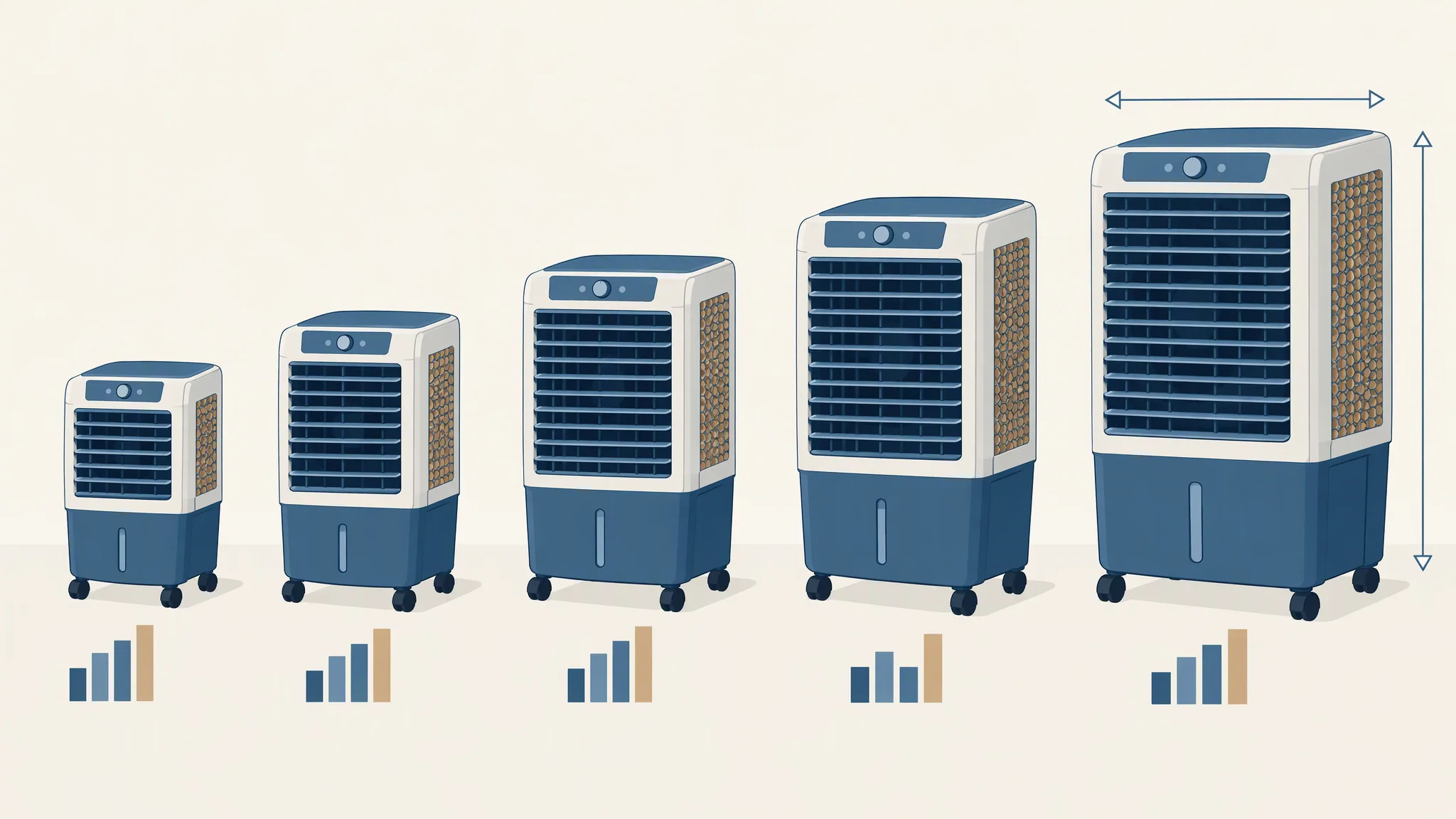
A hall, a workshop, a shop floor with the roller door up: sizing a cooler looks like one question with one number behind it. Run the arithmetic every guide offers and a figure in CFM comes out. Then open a cooler catalogue and find units that share that figure and its tank and differ everywhere else — 75 W against 125 W, six speed settings against three, a 24 V DC supply against a blank. Evaporative cooler sizing does not end at the airflow figure. The figure selects a band; the other fields in the record select the unit you can run, refill and ship.
What does evaporative cooler sizing actually decide?
Two things, and only the first is arithmetic: the airflow band the space needs, and which record inside that band fits the site — its power, pad, tank, controls and supply.
The guides we read answer the first question for fixed, ducted installations. The Building America Solution Center's guide to evaporative cooling systems sizes a cooler by airflow rather than by tonnes of cooling, puts common residential units at 3,000 to 6,500 CFM, and works from air changes per hour. Our cooler records are plug-in, direct-discharge units: no duct run, no relief damper, no blower curve to read. So the calculation gives a band, and the record has to give the rest. What the airflow figure itself measures is set out in our article on the airflow rating.
How much air does the space ask for?
Multiply the volume by the air changes you want and divide by 60. That is the band, in CFM. The same guide gives 20 to 40 air changes an hour for a home at its region's 1% summer design conditions, and its worked example is a 2,000 sq ft house with 8 ft ceilings, 20 changes, 5,333 CFM. Portacool's warehouse cooling guide runs the same formula over a different range, 6 to 30 changes an hour, and cites the ASHRAE 62.1 minimum of 0.06 CFM per square foot — 1,020 CFM for a 17,000 sq ft building. That last figure is a ventilation minimum, not a cooling rate.
Our records state airflow in m³/h, so convert before you compare: multiply a CFM band by 1.699. The 5,333 CFM example is about 9,060 m³/h, the 1,020 CFM minimum about 1,733 m³/h, and the 3,000 to 6,500 CFM residential range about 5,100 to 11,000 m³/h. A band is then divided rather than matched: divide it by the airflow of a unit and the answer is the count the band needs, which is how PolarCool's sizing walk-through sets out the division. At 4,500 m³/h, 9,060 m³/h is two units. The warehouse guide reaches a count the other way round, by splitting the space into zones first; the order matters, because a band divided across units that cannot be placed where the air is needed leaves part of the space uncovered.
Then the part that makes an assumption worth writing down. Two guides that come up for this question tell the reader to divide the room's volume in cubic feet by two and treat the answer as the CFM needed: Cajun Kooling's sizing guide does, and the same walk-through above applies it to a 30 × 60 ft building with 10 ft ceilings. Worked back, dividing volume by two is exactly 30 air changes an hour — inside the domestic band, above most of the warehouse range. The same shed therefore sizes at a little over 1,000 CFM under one rule and at 30 air changes under another. Neither rule is wrong; they assume different spaces and different working conditions. What transfers between suppliers is the assumption, not the CFM.
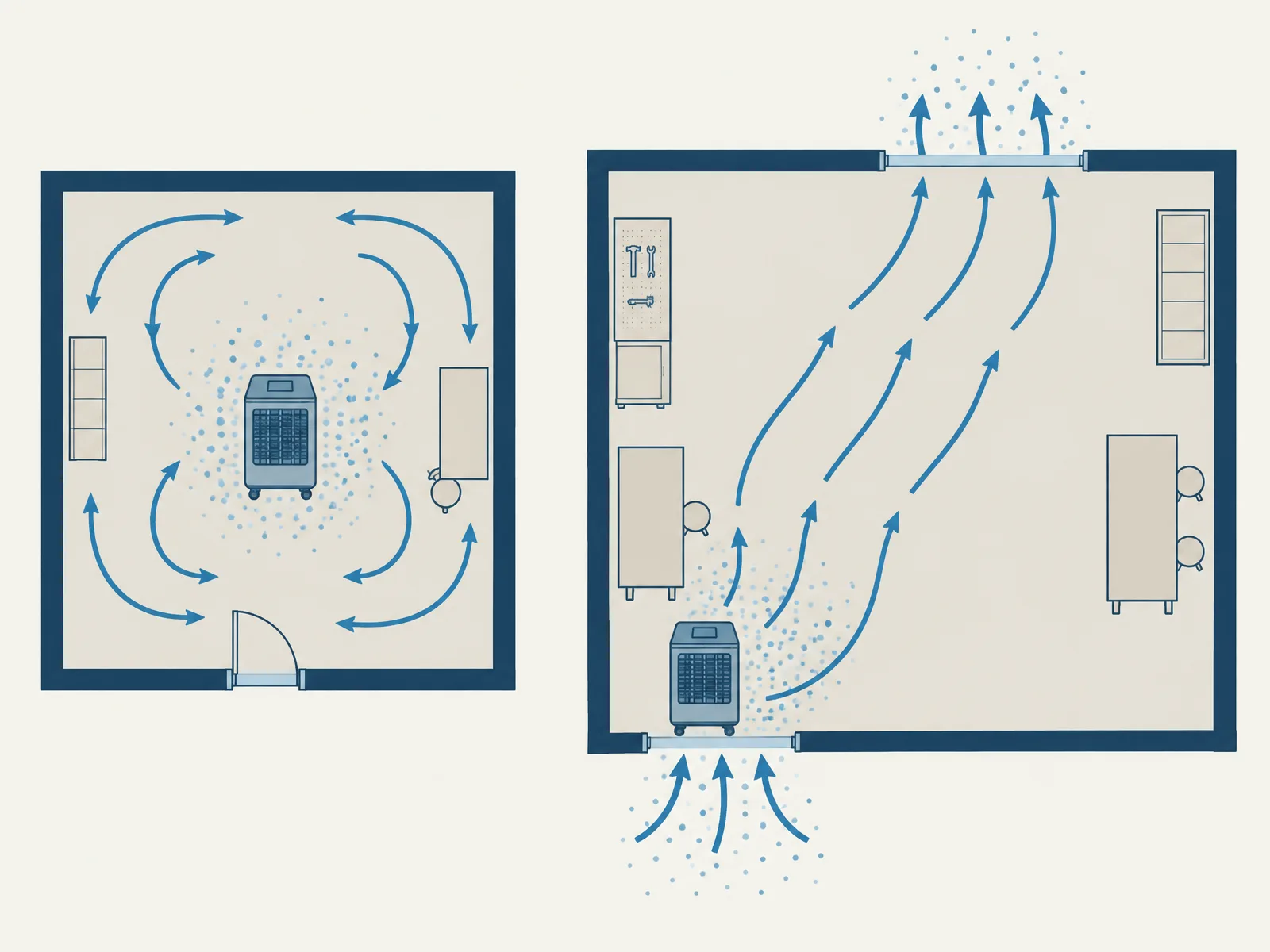
Some guides stack percentage allowances on the result instead — 25% for ceilings above 12 ft, 30% for weak insulation, 50% for outdoor use and 25% for spot cooling, in the walk-through — and each of those is a judgment made before anyone has measured the site. Two site facts move the band further than they do. Where the air can leave: the guide asks for 2 sq ft of unrestricted relief for every 1,000 CFM, and a plug-in unit in a closed room has nowhere to push the air it moves. Which zones it must reach: Portacool splits a warehouse into zones and places units where racking and equipment will not block the flow.
Why does humidity cap the figure before floor area does?
Because a direct cooler's leaving-air temperature follows the wet-bulb temperature of the incoming air, not the size of the room. The same guide works two cities: Phoenix at 108 °F dry bulb with a coincidental 70 °F wet bulb leaves 38 °F of depression to cool with; Sarasota at 92 °F with 79 °F wet bulb leaves 13 °F. It treats wet-bulb temperatures at or below 70 °F as suitable for evaporative cooling. A direct cooler also adds the moisture it evaporates to the air it delivers, which is why a space that exchanges air with outside is a different request from one that does not.
That leaves the wet-bulb side of sizing to the site: temperature and humidity during the hours that matter, which a hygrometer settles in a day. Where the shortlist turns on how far the air temperature drops, ask for the cooling-effectiveness figure for the exact model and the conditions it was measured at, and keep the answer beside the model reference. The guide notes there is no national or international rating organisation for evaporative coolers, with testing guidance in ANSI/ASHRAE Standard 133-2008, which is why an effectiveness figure means something only with its conditions attached.
Which fields decide between two coolers at the same airflow?
Four do, and they sit in the record: tank, pad, rated power, speed settings — plus the supply line where the record states one. Here is the ladder across the current cooler records, read against the fields that differ:
| Model | Airflow | Tank | Cooling pad | Rated power | Speeds | Supply in the record |
|---|---|---|---|---|---|---|
| WJD980F-3M | 980 m³/h | 5.5 L | 30 × 210 × 265 mm | 90 W | 3 | — |
| WJD980F-1L | 980 m³/h | 18 L | 215 × 40 × 270 mm | 90 W | 3 | — |
| WJD2800F-2Z | 2,500 m³/h | 28 L | 360 × 65 × 495 mm | 125 W | 3 | — |
| WJD2800F-3D | 2,500 m³/h | 28 L | 360 × 65 × 495 mm | 75 W | 6 | 24 V DC |
| WJD4500F-1Z | 4,500 m³/h | 42 L | 385 × 90 × 530 mm | 125 W | 3 | — |
| WJD4500F-1D | 4,500 m³/h | 42 L | 385 × 90 × 530 mm | 75 W | 6 | 24 V DC |
| WJD8000F-1M | 8,000 m³/h | 80 L | 75 × 520 × 690 mm | 200 W | 3 | — |
Airflow, tank and supply are as our cooler comparison table states them; rated power, pad dimensions and speed settings sit on the model records. A dash means the record gives no figure for that field.
Power. The same airflow arrives with different rated power: 2,500 m³/h at 125 W or 75 W, 4,500 m³/h at 125 W or 75 W. That difference is the circuit, the adapter and the battery option rather than the headline. A site whose outlets cannot carry a 125 W unit has not lost the 4,500 m³/h family: the -1D record is the same airflow at 75 W.
Speed settings. Six steps against three, at the same airflow and the same tank. Where the unit will spend the day below its top setting, ask what the airflow and the draw are at the step you will use. A published figure belongs to one setting.
Pad. The pad grows with the range — 30 × 210 × 265 mm on WJD980F-3M, 360 × 65 × 495 mm at 2,500, 385 × 90 × 530 at 4,500, 75 × 520 × 690 at 8,000 — but not only with airflow: WJD980F-1L carries a 215 × 40 × 270 mm pad at the same 980 m³/h as WJD980F-3M, with an 18 L tank against 5.5 L. Effectiveness depends on the velocity of air through the media and on the media's condition, so two units at one rated airflow with different pad faces are not the same evaporation surface. Pad dimensions belong on the shortlist sheet beside the airflow figure.
How does the tank change what you can buy?
Tank size is not a function of airflow, and the catalogue shows it. The ladder runs from 4 L and 5 L on the smallest models through 5.5 L at 980 m³/h, 8 L and 20 L at 800, 18 L at 980, 28 L at 2,500, 42 L at 4,500 and 80 L at 8,000. Two records at one airflow can sit far apart: WJD980F-3M at 5.5 L and WJD980F-1L at 18 L, both at 980 m³/h.
The tank then changes the carton, and the carton changes the order. LZ06EX-8L and LZ06EX-20L share 800 m³/h, 60 W, three speeds and the same control, and differ in the reservoir: a 326 × 318 × 700 mm carton against 322 × 314 × 826 mm — 126 mm taller for the larger tank at the same airflow. A loading plan built on one is wrong for the other. The tank also decides who refills the unit mid-shift and from where, which is a site question rather than a catalogue one, and the figure on the paperwork has to be the confirmed one, as the correction we published for three models' tank figure shows.
What do the power and supply fields say about the site?
They say whether the unit can be fed where it stands. Rated power across the current ladder runs from 75 W to 200 W, and the supply line is filled where the record has it: 12 V DC on WJD880F-1D, 24 V DC on WJD2800F-3D, WJD4500F-1D and WJD4500F-2D, and 110 V 60 Hz or 220 V 50 Hz on LZ05EX. Most rows of our cooler comparison table read "Not specified — confirm" instead, which is the honest answer rather than 220 V/50 Hz assumed from the majority of the range.
That is the field to confirm for the destination. A market on 60 Hz, or a site with no convenient outlet, narrows the shortlist to the records that state their supply, and for the rest the question goes into the message. Ask it per model reference, because the supply belongs to the record and not to the family.
Does the space need a ducted system instead?
Our cooler records are plug-in, direct-discharge units, and a space that has to be cooled through ductwork is a different class of equipment with its own sizing: the guide describes ducted systems with a relief path and ductwork sized to a standard. If ductwork is part of the plan, say so in the first message; it changes which records are relevant.
What goes on the shortlist sheet?
Five site lines, then one line per shortlisted model, on one page.
- The space. Dimensions, ceiling height, and the racking, partitions or equipment that will block a flow.
- Where the air leaves. Openings and their height, and whether they are open during the hours that matter.
- The climate. Temperature and relative humidity, or the wet-bulb reading, through the working day.
- The supply. Voltage and frequency available, how far the unit sits from an outlet, and whether it must run without mains power.
- The tank routine. Who fills it, from where, and how often a shift allows.
Then, per model: airflow with its setting, pad dimensions, tank, rated power, speed settings and supply. Send the same sheet to each supplier you compare, so their replies line up — the commercial lines, from quantity and market to packing and terms, go on that same page, as the one-page brief we ask for before a price sets out.
The confirmed figures for the current range sit in our cooler comparison, each model opens its own record — WJD4500F-1D carries the full parameter table and the 42 L tank — and the larger models are gathered on the commercial cooler page. When the sheet is ready, send it through the inquiry form: two or three model references with the site notes beside them turn a price list into a comparison.
Related reading
Evaporative Cooler CFM: What the Airflow Rating Measures
One airflow figure is one speed setting, not a whole machine: how m³/h and CFM convert, what a rating leaves out, and four fields to confirm before an order.
Read articleEvaporative Cooler Quotation: What to Send Before You Ask
Which fields a factory can actually price from, which ones only produce a question, and the terms and documents worth putting in writing in your first message.
Read article
Filed under Air Cooler Selection
Back to Blog