
Evaporative Cooler CFM: What the Airflow Rating Measures
One airflow figure is one speed setting, not a whole machine: how m³/h and CFM convert, what a rating leaves out, and four fields to confirm before an order.
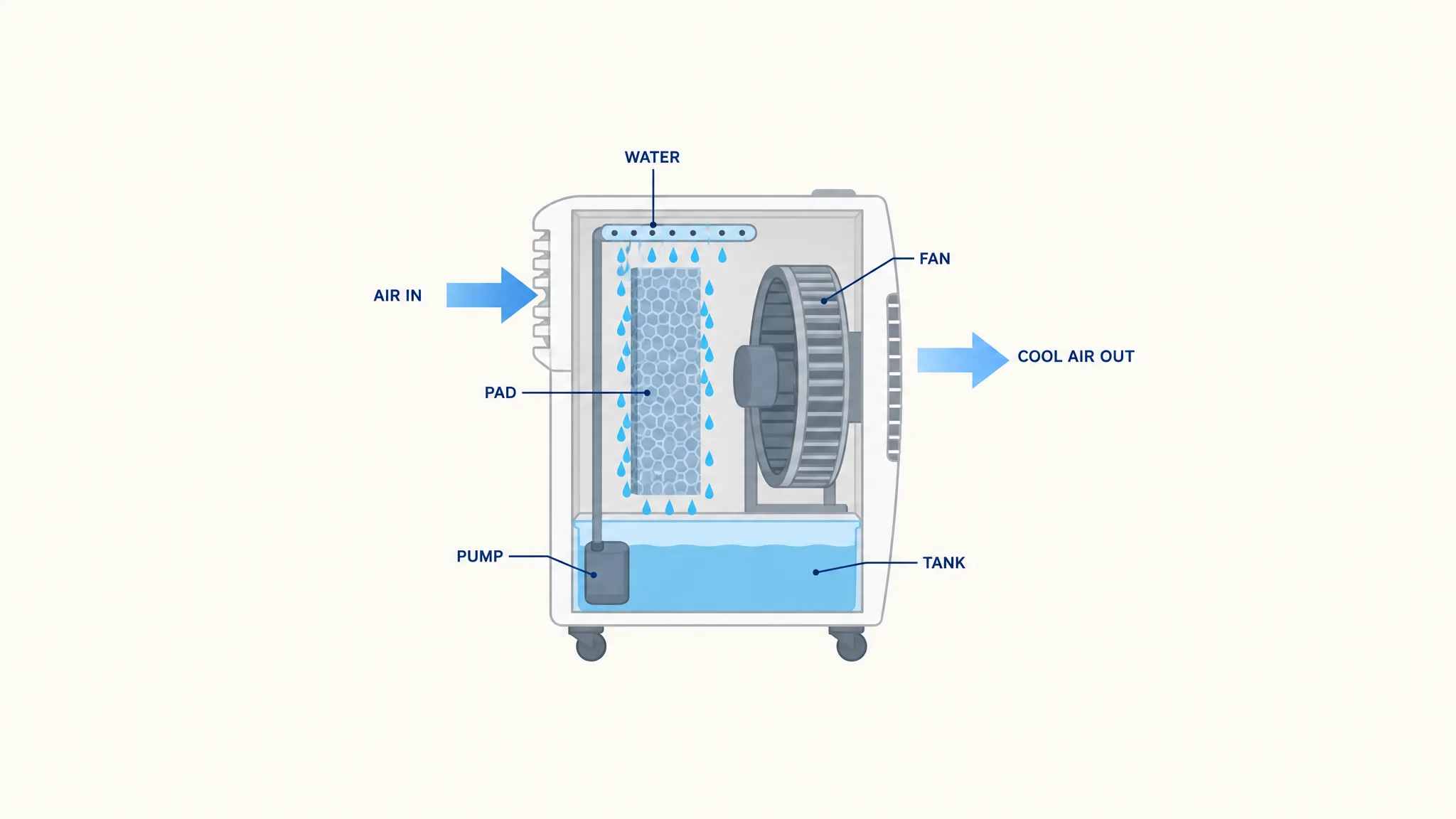
Two requests come back for the same class of portable cooler: one quoted at 4,500 m³/h, the other at 2,649 CFM. That is one figure in two units, and neither version tells you what the machine will do in your space. An evaporative cooler's CFM figure measures air at one operating point; reading it as a promise about a room is where model choices go wrong.
What does the CFM figure on an evaporative cooler stand for?
CFM means cubic feet per minute: the volume of air the fan and the airways behind it move in a minute. It counts air, not temperature. Our model records state the same quantity in cubic metres per hour, which is why two numbers that look far apart are often one figure in a different unit.
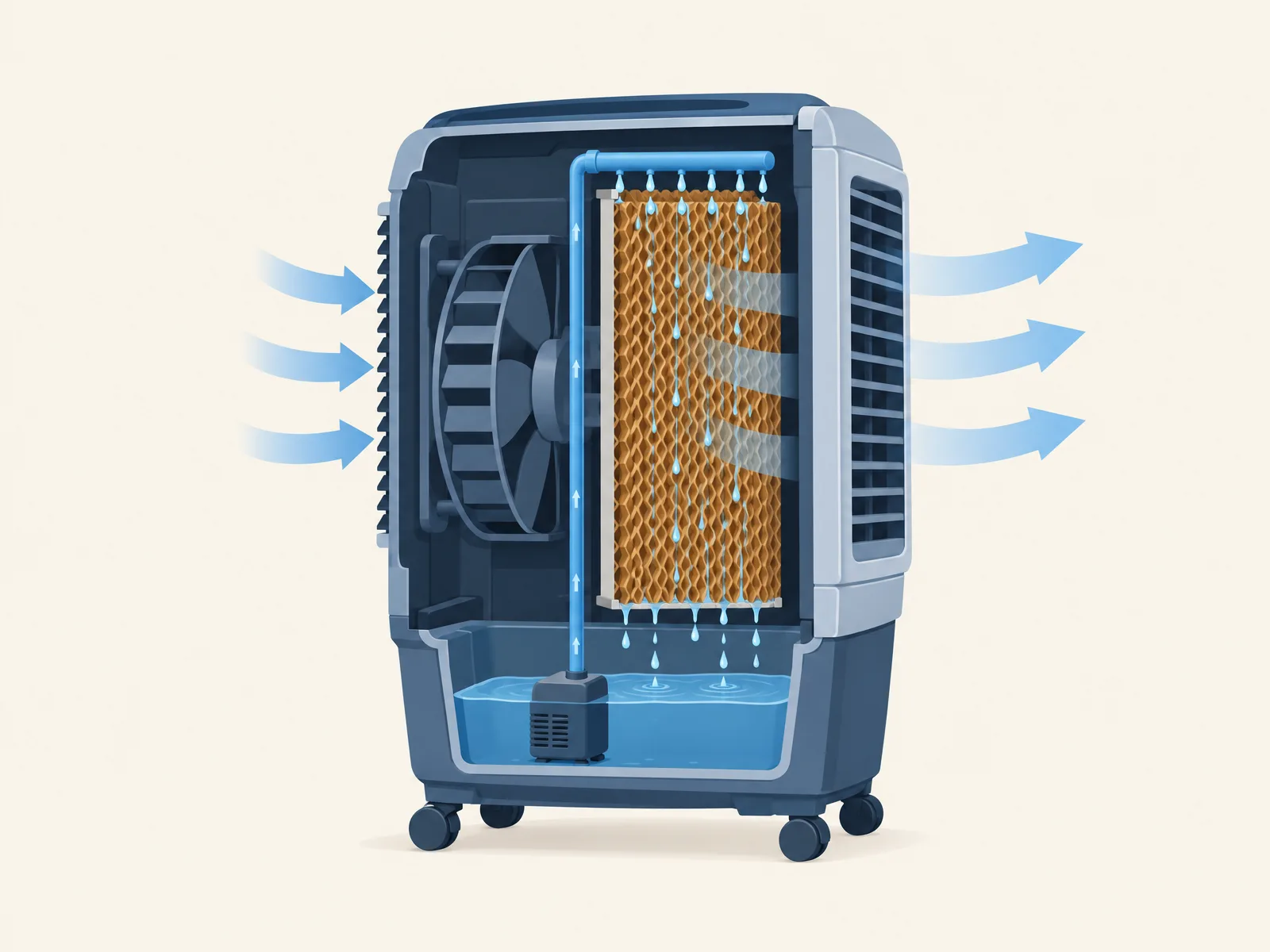
Two distinctions are worth holding from the start. Airflow is not coverage: our cooler comparison table says that tank size and rated airflow alone do not establish coverage, or industrial, outdoor or whole-room suitability, and that is how we would have the column read. Airflow is not cooling either. A cooler adds moisture to the air it moves, and in humid incoming air it generally has less cooling potential than in dry air, as the same page notes. The figure counts air. What that air does to a room depends on how dry it is and where it can leave.
How do I convert m³/h to CFM without muddling the comparison?
Multiply the m³/h figure by 0.5886. One cubic metre is 35.31 cubic feet and an hour is 60 minutes, so 1 m³/h = 0.5886 CFM; the other way, divide a CFM figure by 0.5886, or multiply by 1.699, to get m³/h.
Every airflow figure in our current cooler records, converted:
| Stated figure | Approximate CFM | Where it appears in our records |
|---|---|---|
| 800 m³/h | 471 | WJD880F-1D |
| 900 m³/h | 530 | WJD980F-3D |
| 980 m³/h | 577 | WJD980F-3M and WJD980F-1L |
| 1,800 m³/h | 1,060 | WJD4500F-2Z, low setting |
| 2,500 m³/h | 1,471 | WJD2800F series |
| 3,200 m³/h | 1,884 | WJD4500F-2Z, medium setting |
| 4,500 m³/h | 2,649 | WJD4500F-1D, -1Z and -2Z, high setting |
| 8,000 m³/h | 4,709 | WJD8000F series |
Two habits keep the converted sheet honest. Round the same way throughout and say on the sheet that you rounded, because 2,648 and 2,649 CFM side by side look like a difference and are not one. Then notice what the arithmetic did not do: it changed the unit, not the basis. A converted figure still carries whatever condition the original was measured under.
Why can two coolers both listed at 4,500 m³/h behave differently on site?
Because the number belongs to one speed setting and one electrical configuration, not to the cabinet. Our comparison table has a single airflow column, labelled "High airflow / stated airflow", and 4,500 m³/h appears in it three times: WJD4500F-1D, WJD4500F-1Z and WJD4500F-2Z. The rows around that figure differ. The WJD4500F-1D record is a 24 V DC unit rated 75 W with six speed settings. The WJD4500F-2Z record is rated 125 W with three settings, and its supply reads "Not specified — confirm" in the table. The WJD4500F-1Z is rated 125 W and carries the same supply note.
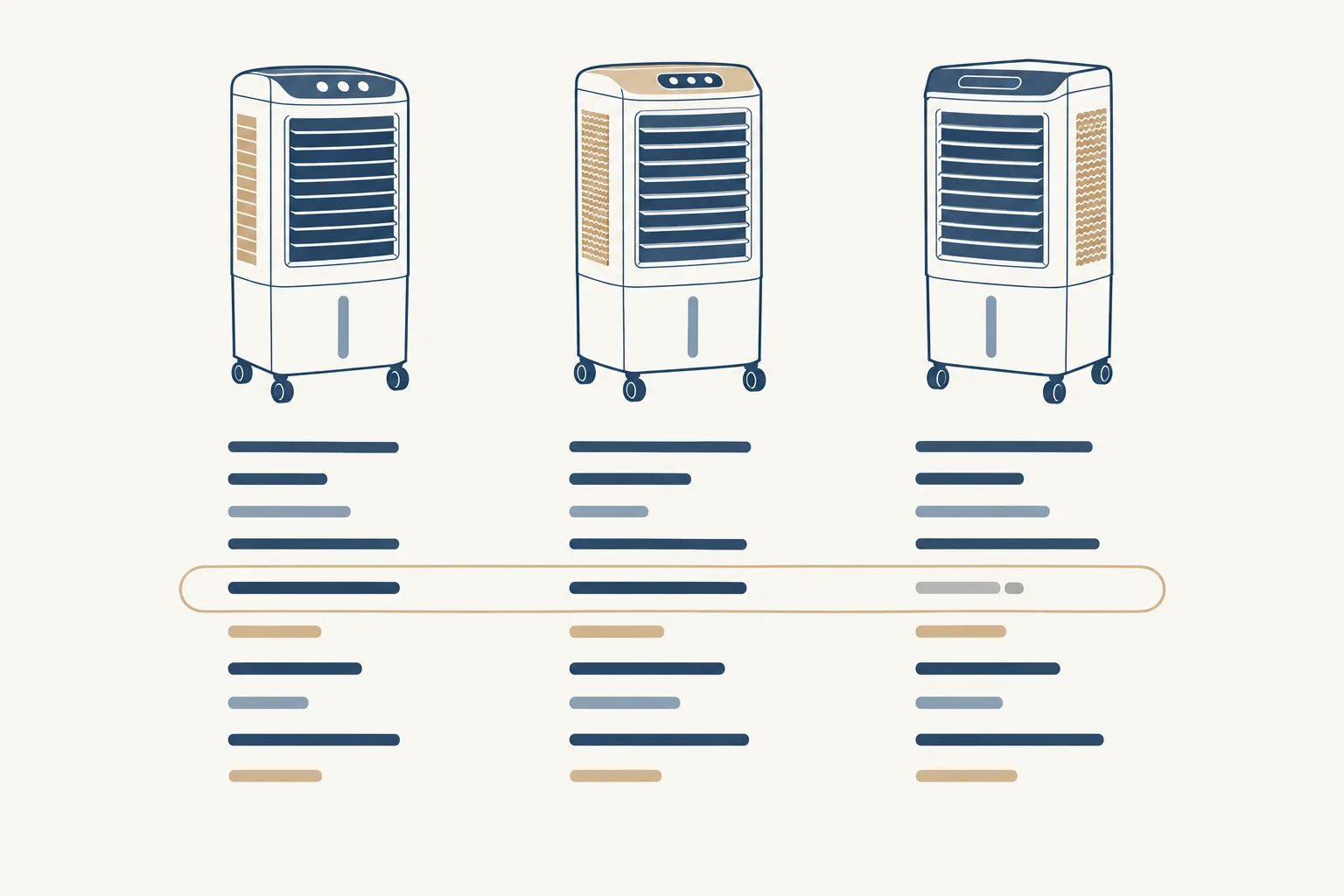
A buyer who compares those three on the headline has compared the one field they share. Wattage, speed settings and supply are what differ, and each of them changes how the unit behaves once it is running. When a shortlist is built on airflow alone, the comparison has not started yet.
Which speed setting is the published figure measured at?
On the record that splits the figure by setting, it is the top one. WJD4500F-2Z lists 4,500 m³/h at high, 3,200 at medium and 1,800 at low against a three-setting control, so the low setting moves 40 per cent of the headline figure.
Most of our records state the figure once. WJD4500F-1D gives 4,500 m³/h alongside six speed settings; the WJD980F-3D record gives 900 m³/h with six; and the WJD2800F-3D record states 2,500 m³/h with its speed settings still to be confirmed. Read a single published figure as the ceiling of what that record promises, not as the setting the unit will run at through a working day. Where the setting matters to your decision — and it does wherever people work at a distance from the outlet — ask for the figure at that setting and keep the answer beside the model reference.
Does the model number give me the airflow?
Not reliably. The digits match the figure on some series: WJD980F-3M and WJD980F-1L at 980 m³/h, the WJD4500F models at 4,500, the WJD8000F models at 8,000. They do not on others. Every WJD2800F record states 2,500 m³/h, not 2,800. And WJD980F-3D, inside the same 980 series, states 900 m³/h.
If a purchasing sheet already reads "2,800 m³/h" because the code looked like a capacity, correct it to the stated 2,500 before it travels further, or the order will be sized against a figure no record carries.
What does the figure leave out?
The conditions it was measured under. Airflow taken at free discharge from the outlet, and airflow taken downstream of the wet pad, the grille and the louvres, are different numbers, and a sheet seldom says which one it holds. An installation adds to that: louvres, filters and duct runs resist the flow, so what reaches the far end of a run is lower than what leaves the unit.
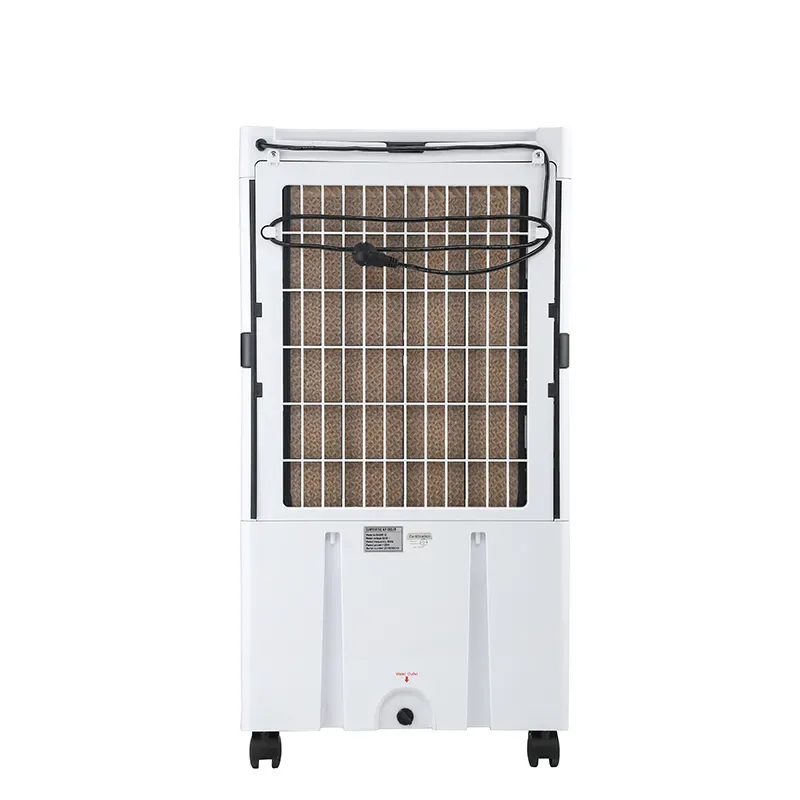
This is not a quirk of one catalogue. Premier Industries publishes its ducted cooler charts as delivered airflow rather than a single rating, and names duct runs, filters, louvres and static pressure among the things that reduce the delivered figure. Those charts are for ducted, fixed installations and ours are plug-in, so their numbers do not transfer to our models — the lesson does. Ask which basis a figure was measured on, and where that answer is not available, treat the figure as an upper bound and write it up that way.
What should the request ask for so two quotes compare?
Four things, each attached to the model reference:
- The setting. The figure you need, at the speed the unit will run.
- The basis. Whether it is stated at free discharge or after the pad and grille.
- The supply. Voltage and frequency at the site, and how the unit will be fed.
- The rated power. The watts that configuration draws.
Add the space and how the air leaves it, because those decide whether the airflow reaches anyone at all. The one-page brief we ask for before a price already carries the supply line, the quantity, the market and the packing lines; write the setting, the basis and the rated power onto the same sheet, so that one file sent to two suppliers makes their replies line up.
Should a CFM-per-square-metre rule choose the model?
Not from these records, and not with arithmetic borrowed from another class of equipment. Our model records carry no cooling-area figure, and the comparison page is explicit that airflow alone does not establish whole-room suitability. The sizing charts you will meet are written for fixed, ducted installations whose ranges run from about 1,000 to 67,000 CFM, with a blower, ductwork and a building to move the air through. A plug-in cooler listed at 4,500 m³/h is 2,649 CFM. Carrying a rule of thumb built for the first across to the second produces a precise number that decides nothing.
What does decide is the space: how many people are in it, where air enters and where it leaves, and the temperature and humidity during the hours that matter. A closed shop and the same shop with the roller door up are two different requests, and they come back as different answers.
How is the airflow written in our records?
Each model carries the figure confirmed for it: once where that is what the source gives, split into high, medium and low where the source splits it, as on WJD4500F-2Z. The supply rows read "Not specified — confirm" in six of the seven cases rather than a guessed voltage. A field filled with a number nobody can stand behind becomes a wrong figure in someone's order specification, and a capacity figure corrected after the fact is the reminder of how far one wrong field travels.
Two suppliers' airflow figures are comparable only when each carries its setting and its basis. Write the model reference, the setting, the basis, the supply and the watts into one line per model, send the space notes with it, and the reply that comes back is a comparison rather than a conversation.
Filed under Air Cooler Selection
Back to Blog