
How Do Bladeless Fans Work? The Blades Sit in the Base
The impeller sits in the base and a slit in the loop multiplies the flow. What the mechanism is, and how to check a bladeless claim.

Where are the blades in a bladeless fan?
Inside the base. What looks like an empty loop, held up by a stem, is fed by a small impeller — a motor and blades — hidden in the base, and the loop itself has no moving part at all. Calling the product bladeless is a description of the front of the machine, not of the mechanism. HowStuffWorks describes the Dyson Air Multiplier, launched in 2009, as a motor turning nine asymmetrically aligned blades that pull air into the pedestal, then feeding it up into the circular tube and out through a slit inside it.
So the first answer to how do bladeless fans work is unglamorous: a conventional fan, in a place you cannot see, plus a nozzle that turns its output into a sheet.
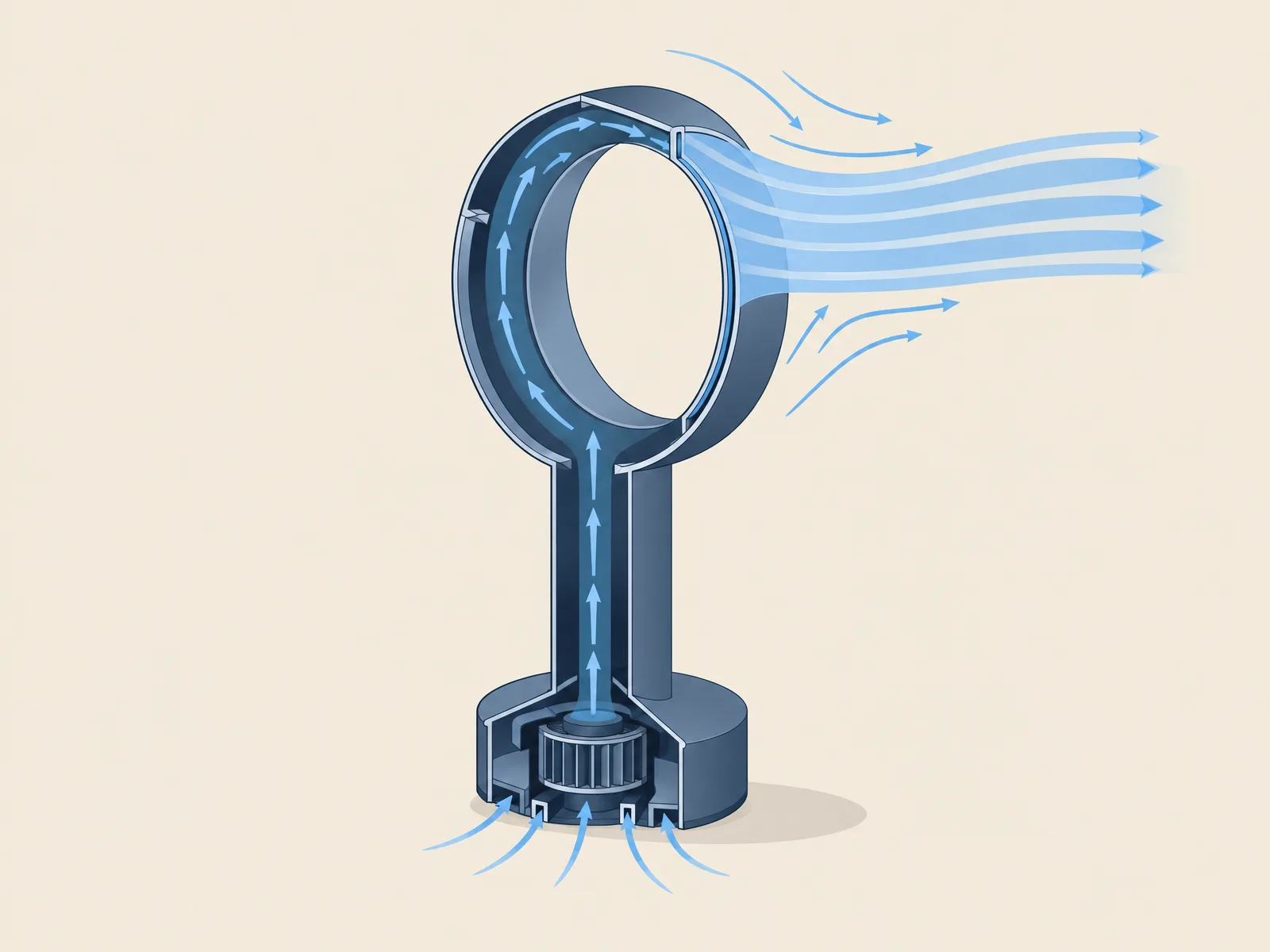
What does the loop actually do?
It converts a small, fast stream into a larger, slower one. The impeller accelerates air into the loop; the loop releases it through a narrow slit that runs around its inner edge; the air leaves as a thin sheet that follows the curve of the loop's inner surface — the Coanda effect — and that sheet drags more air with it. Air behind the fan is pulled forward (inducement) and air around the edges of the loop joins in (entrainment), which is where the extra volume comes from.
Hardware FYI, an engineering newsletter, summarises the same mechanism: an impeller draws air into the base and accelerates it through a narrow slit around a hoop-shaped airfoil, and the resulting low-pressure zone plus entrainment amplifies the total volume. For the person in front of it, the consequence is a steady sheet of air rather than the short gusts a set of blades sends across a room.
Is the airflow really multiplied fifteen times?
That figure is a manufacturer's claim about its own design, not a property of every loop-shaped fan. HowStuffWorks reports Dyson's claim that its fans increase output to fifteen times what the base takes in, and Hardware FYI repeats the same figure as a ceiling for the technology. Both are reporting a claim, not a test you can apply to the unit in front of you.
What a buyer can compare is duller and more useful: a stated airflow figure with the conditions it was measured under, noise at a stated setting and distance, and power input. If a supplier quotes a multiplication factor, ask for the test behind it and for the airflow figure in the unit the factor describes.
Does bladeless mean quieter or cheaper to run?
Not by itself. The first Air Multiplier was not a quiet machine, and the noise came from turbulence inside the base; the second generation added Helmholtz cavities to break that up, and was claimed to be 75% quieter with a motor needing 40% less power, according to HowStuffWorks' account of the redesign. Those are one company's engineering decisions over two generations, not something the word bladeless buys you. Compare power input and noise figures with their conditions.
One more thing the shape does not tell you: whether the loop is easy to clean. A slit and an inner ring collect dust the way any grille does, so ask what the manufacturer's instructions say about cleaning, and how access is gained.
How do I check a bladeless claim in a catalogue?
Two questions, both answerable from a photograph: where is the impeller, and through what does the air leave?
An oval opening is not a mechanism. Our two compact tower-form fans, X28 and A-01, are recorded with open oval bodies, six settings and an ABS housing — and the selection page says plainly that an open oval form does not establish a bladeless mechanism. What the record does not say is what happens inside the housing. That is the question for the supplier, and it is answered by a photograph of the base with its cover removed, or a cut-away drawing.
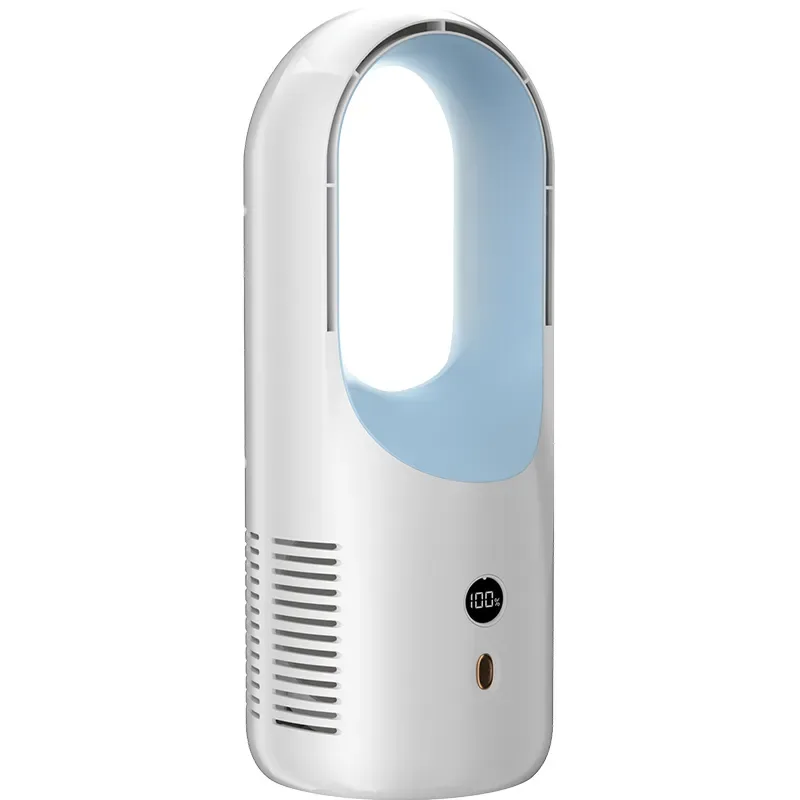
We have had a reminder of the same lesson in our own catalogue. The page at the address we still serve for Y-3 describes a short-stem desktop fan with a round outlet, 9 W and three settings: a visible grille on a round head, not a loop. The address is old and the product record is what it is. Where a name and the mechanism disagree, the mechanism decides — and a buyer comparing catalogues should ask for mechanism evidence before treating a line as a bladeless product at all.
What should I confirm before specifying one?
- Mechanism evidence. A photograph of the base assembly, or a cut-away, showing the impeller and the slit.
- Airflow. The figure, and the conditions and setting it was measured at.
- Noise. A figure with the setting and the distance, not an adjective.
- Power and supply. Power input, and whether the inlet is AC or DC; our own records list 5 V for several fan models and leave the AC/DC type and any adapter to confirm, which is a question for the quotation rather than an assumption.
- Cleaning and maintenance. What the model's instructions say, and whether a replacement part exists.
Send the intended use, the airflow you need and the destination market to our team, and we will answer from the model record — including saying when a product is not bladeless at all.