
Are Air Purifiers Like Fans? What the Filter Changes
A purifier is a fan with a filter in its air path. What that changes in a room, and how our four configurations differ.
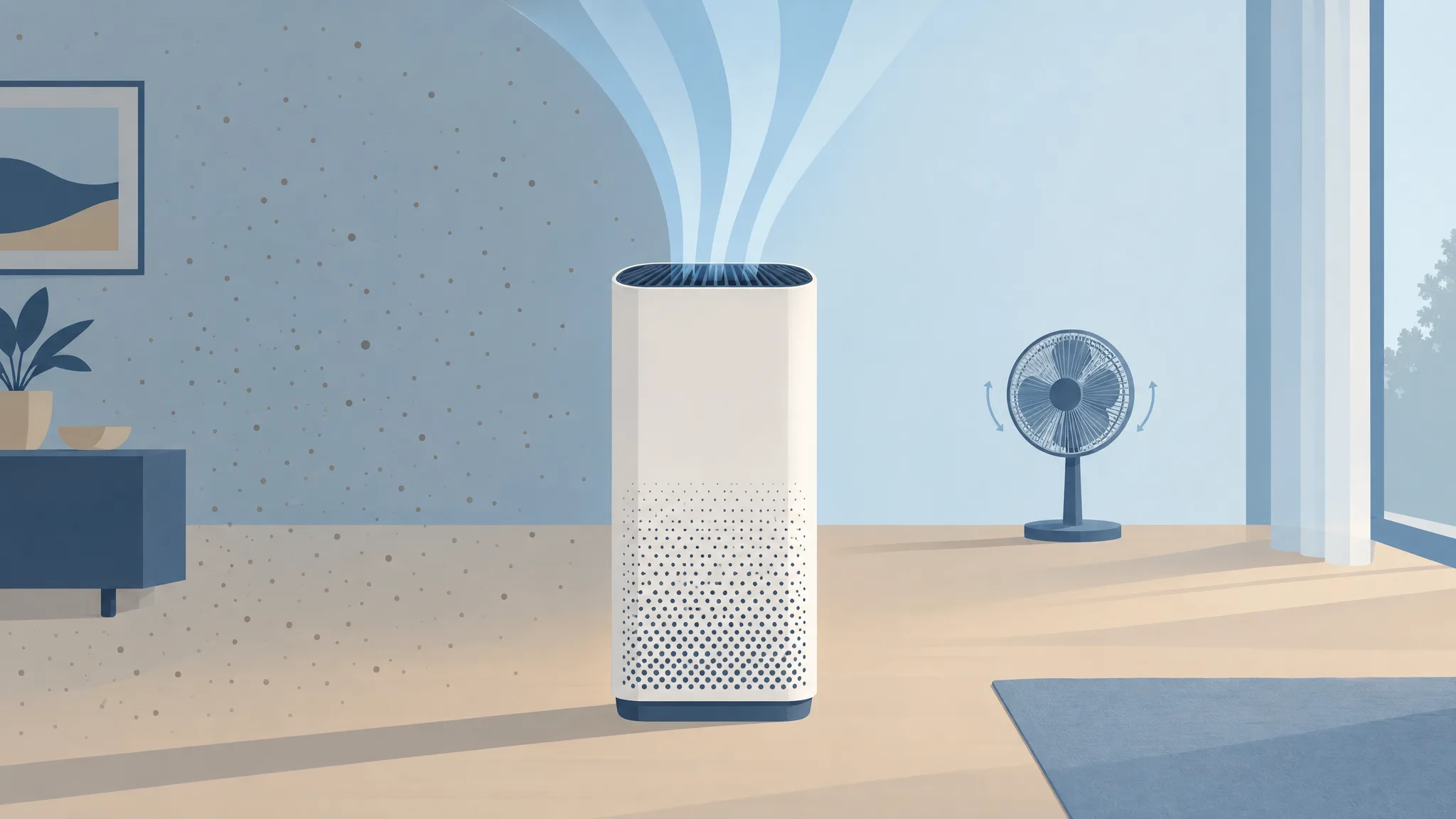
Are air purifiers like fans?
Are air purifiers like fans? Partly — and the part that matters is what sits in the way of the air. A fan takes in room air and sends it back into the room; a purifier takes in room air, pushes it through a filter, and sends it back. Both are the same machine moving air. Only one of them changes what that air carries.
That is why the question "purifier or fan" is the wrong one to take into a supplier meeting. The useful question is what the air passes through, and whether the fan is strong enough to push the room's air through it often enough to matter.
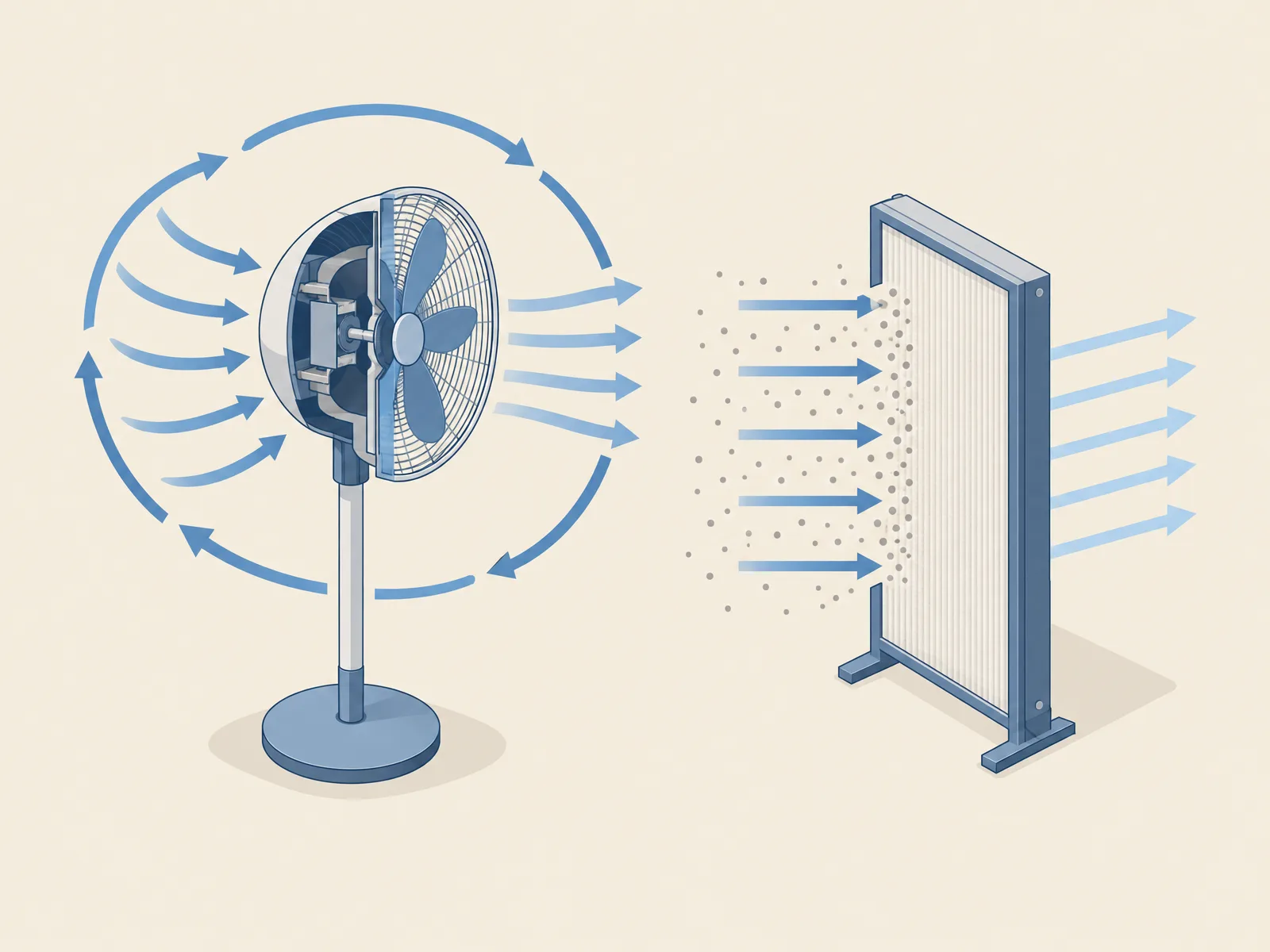
What does each one do to the air in a room?
| Fan | Air purifier | |
|---|---|---|
| Air path | Room → fan → room | Room → fan → filter → room |
| What it changes | Air movement and distribution | What the air carries, once it passes the filter |
| What it does not do | Remove particles or gases; change the temperature | Cool or heat the room; remove every pollutant |
A fan makes a still room comfortable and moves air between zones, which is worth having on its own. A purifier does that too, incidentally, but its purpose is filtration — and filtration depends on the filter matching the pollutant. The US Environmental Protection Agency's guide to air cleaners in the home puts it plainly: most filters are designed for either particles or gases, so removing both usually takes two filters.
Why a purifier cannot work without its fan
Because a filter only removes what passes through it, and how much passes through is set by the fan. The EPA guide states that higher fan speeds and longer run times increase the amount of air filtered, and that a cleaner set at a lower speed filters less. The same guide reminds buyers that all filters need regular replacement: a dirty, overloaded filter does not work well.
So the fan in a purifier is not the extra feature. It is the engine that makes the filter do anything at all, and its speed setting is part of the product's performance, not a comfort control.
What a purifier does not do
Four limits are worth carrying into a specification conversation:
- It does not replace source control and ventilation. The EPA's most effective measures for indoor air remain removing or reducing pollutant sources and ventilating with clean outdoor air; filtration is a supplement.
- It does not remove all pollutants. The EPA guide says portable air cleaners cannot remove all pollutants from the air.
- It does not solve a damp or mould problem. Mould comes from moisture; a cleaner may take some particles out of the air but does not address the cause.
- A safety mark is not a filtration result. The EPA does not certify or recommend brands or models, and the clean air delivery rate (CADR) rating system covers particles, with no widely used rating for gas removal. The guide also advises avoiding cleaners that intentionally produce ozone.
What do our four purifier configurations show about the fan?
In our purifier range the fan is not an abstraction — it is a part you can see in the configuration list. Four models share one 55 W, 220 V / 50 Hz record and split two ways:
| Model | Configuration | Water tank | Product dimensions | Net weight |
|---|---|---|---|---|
| WJD8050B | Purifier body | Not specified — confirm | 250 × 250 × 460 mm | 3.8 kg |
| WJD8050A | Purifier + humidifier, no external fan head | 3.6 L | 250 × 250 × 460 mm | 3.8 kg |
| WJD8060B | Purifier + external fan head | Not specified — confirm | 250 × 250 × 610 mm | 4.9 kg |
| WJD8060A | Purifier + humidifier + external fan head | 3.6 L | 250 × 250 × 610 mm | 4.9 kg |
Read the configuration column against the dimensions: the two 8060 models carry a fan head above the purifier body, and the taller body is recorded at 610 mm and 4.9 kg against 460 mm and 3.8 kg for the body alone. That is the plainest answer to whether a purifier is like a fan — here the two are separate assemblies, and a buyer can order one configuration or the other.
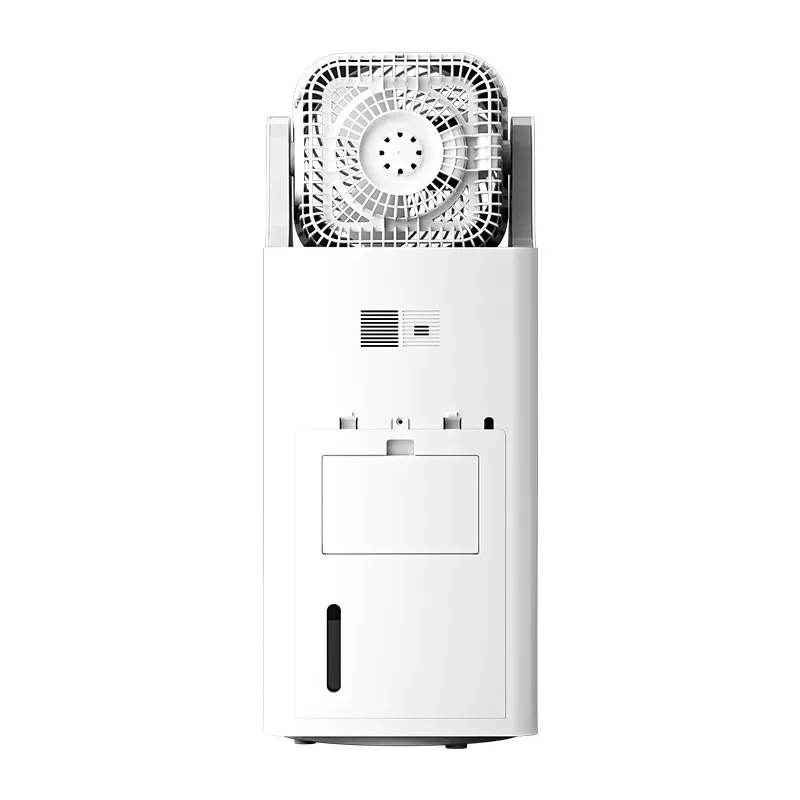
What the shared 55 W figure does not tell you is how well any of them filters. Our category page says so directly: the electrical rating and the safety record do not demonstrate CADR, filtration grade, room coverage or health effects. If filtration performance decides your order, it has to come from a test you specify, not from a line on the price list.
Which one should a buyer specify?
Match the device to the job rather than to the category:
- Comfort and air movement only. A fan. It will not clean the air, and it does not claim to.
- Particles in a single room. A purifier with a clean air delivery rate sized to the room: the EPA guide pairs room area with a minimum figure, from 65 cfm for 100 sq ft to 390 cfm for 600 sq ft at an eight-foot ceiling.
- Gases or odours. A filter designed for gases — the EPA notes that activated carbon can be effective where enough material is used, and that no widely used rating system covers gas removal.
- One housing, two jobs. A combined unit is a compromise. Blueair, a purifier manufacturer, argues in its own comparison that dedicated purifiers deliver a higher clean air delivery rate than combination units at the same cost. That is a manufacturer's position, not an independent finding — but the trade-off it describes is the one to test in a quotation: what the same housing gives up when it has to do both jobs.
What should I send in an inquiry?
Tell us the room or the volume, the pollutant you are trying to deal with, and whether you want the humidifier tank, the external fan head, or neither; those two parts are what separate the four configurations from each other. Add the destination market and the plug you need, and the filtration evidence your approval process requires.
Our WJD8060B record shows how one configuration is documented, field by field. Send the same list to our team and we will tell you which of the four fits, and which of your questions needs a test rather than a datasheet.