
How Does a Heat Fan Work? The Air Path, Step by Step
A fan moves the air and an element heats it. Follow the path, then read a heater's two power figures: fan-only watts and heating watts.

What happens to the air between the two grilles?
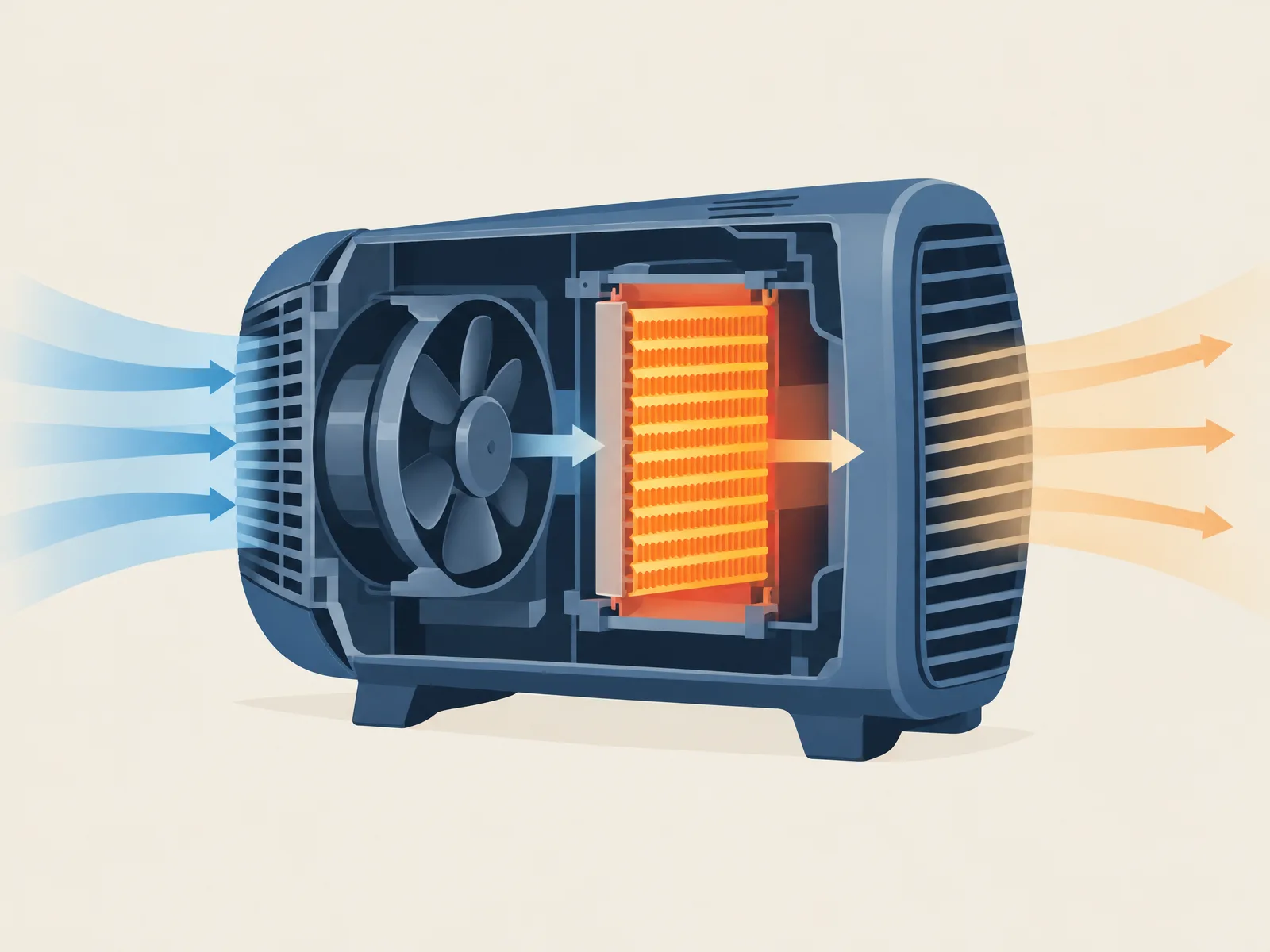
Ask how a heat fan works and the answer is a sequence, not a list of parts. With the unit running, room air enters through the rear intake grille, the fan pulls it in and pushes it forward, the air passes the heating element, and it leaves through the front grille. Nothing is drawn from outside the room and nothing is added to the air: the same air is picked up, warmed or not, and returned to the space.
The order is not accidental. The element sits in the fan's discharge path, so the whole of the airflow crosses it. Put the heater behind the fan instead and the motor, the housing and the controls would take the heat before the air leaving the grille did. That is why a fan heater is a housing with three functional parts in a row — fan, element, and the thermostat and controls that decide when the element is live — as Dyson sets out in its own description of a fan heater.
Where does the heat actually come from?
From resistance in the element, not from the fan. Current through a resistive material produces heat — Joule heating — and the fan's only job is to carry that heat away from the element and into the room.
In the heaters we make, the element is ceramic PTC (positive temperature coefficient). Its resistance rises as it gets hotter, so it draws less current at higher temperature and limits its own temperature rise. Invitop, a heater manufacturer, explains the behaviour and draws the distinction a buyer needs: self-regulation happens inside the element, while keeping a room at a temperature is the thermostat's job. A PTC element is not a room thermostat, and a thermostat does not make an element safe to place anywhere.
What does the fan-only figure on a heat fan mean?
It is the power of the fan on its own, recorded separately from the heating power, and where a record states it, it is a small number: WJD1301R and WJD1302R are recorded at 900 / 1,300 W heating with 8 W fan-only, and WJD801R at 800 W heating with 6 W fan-only.
It is not an extra fan-speed setting, as our PTC heater range says in as many words. The two numbers describe two different jobs in the same housing — making heat, and moving air. The fan is a small axial fan, and the heat is the element's work.
That is also the honest limit of the fan: it moves air, it does not warm it without the element, and nothing in the unit removes heat from the room, so no setting here is a cooling function. Air moved by a fan of a few watts is room-temperature air, and moving air feels cooler on skin than still air of the same temperature.
What do the two figures tell you that one does not?
They describe the two halves of the same machine — how much electricity becomes heat, and how much air carries it. This is the comparison across five models:
| Model | Form | Heating power | Fan-only power |
|---|---|---|---|
| AQL039 | Compact PTC | 800 / 1,200 W | Not specified — confirm |
| WJD501R | Compact PTC | 500 W | Not specified — confirm |
| WJD1301R | Square-body PTC | 900 / 1,300 W | 8 W |
| WJD1302R | Upright PTC | 900 / 1,300 W | 8 W |
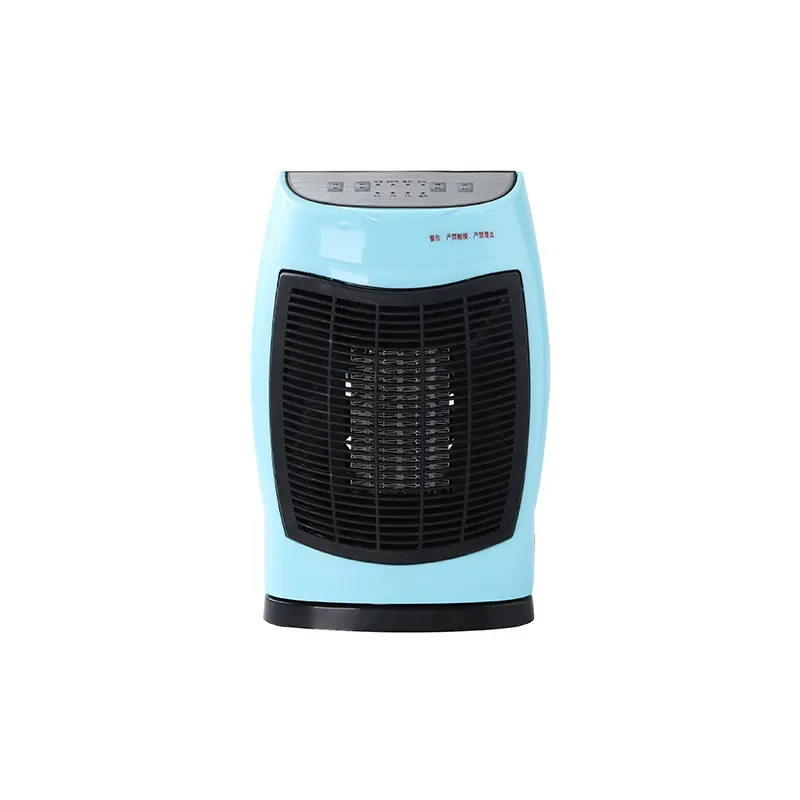
| WJD801R | Cylindrical PTC | 800 W | 6 W |
A blank in the fan-only column is not 0 W, and it is not a quality ranking either. It means the record does not state the figure, and the answer belongs in the inquiry rather than in an assumption — the same rule our WJD1302R specification page applies to every field it holds.
What does a wattage figure not prove?
It is electrical input, not a room result. Two heaters with the same wattage can feel different because of fan speed, outlet shape, oscillation and the distance to the person using them — Invitop makes the same point — and the room itself decides the rest: size, insulation, outdoor temperature, doors and windows, air circulation.
We do not publish a heated-room area for any of these models, because no test of ours establishes one. If your brief depends on a floor area or a temperature rise, ask for a test record with its conditions rather than a headline figure.
What should I confirm before ordering heaters?
Four things, and they come from the exact model rather than the family:
- The power fields. Heating power, and fan-only power where your use depends on it.
- The supply. Voltage, frequency, plug and cable. AQL039's record does not state a frequency; do not assume one.
- Placement and clearance. Ask for the exact model's own instructions. Small dimensions do not establish that a unit is safe on a desk, on a wall or in a socket, and our records make no such claim.
- Documents. Request the safety and destination-market documents by number for the model you are ordering, and check that the model is named in them.
Quantity, sample, packing and lead time are quotation topics, confirmed per order.
Send us the model, the market and the supply you have available at the contact page, and we will answer from that model's record — including the fields that are still blank.