
Air Cooler Problems: Water, Pad and Airflow, in That Order
How to tell a dry pad from a dead pump, the pad and tank figures behind our cooler models, and the checks to run before you buy a part.
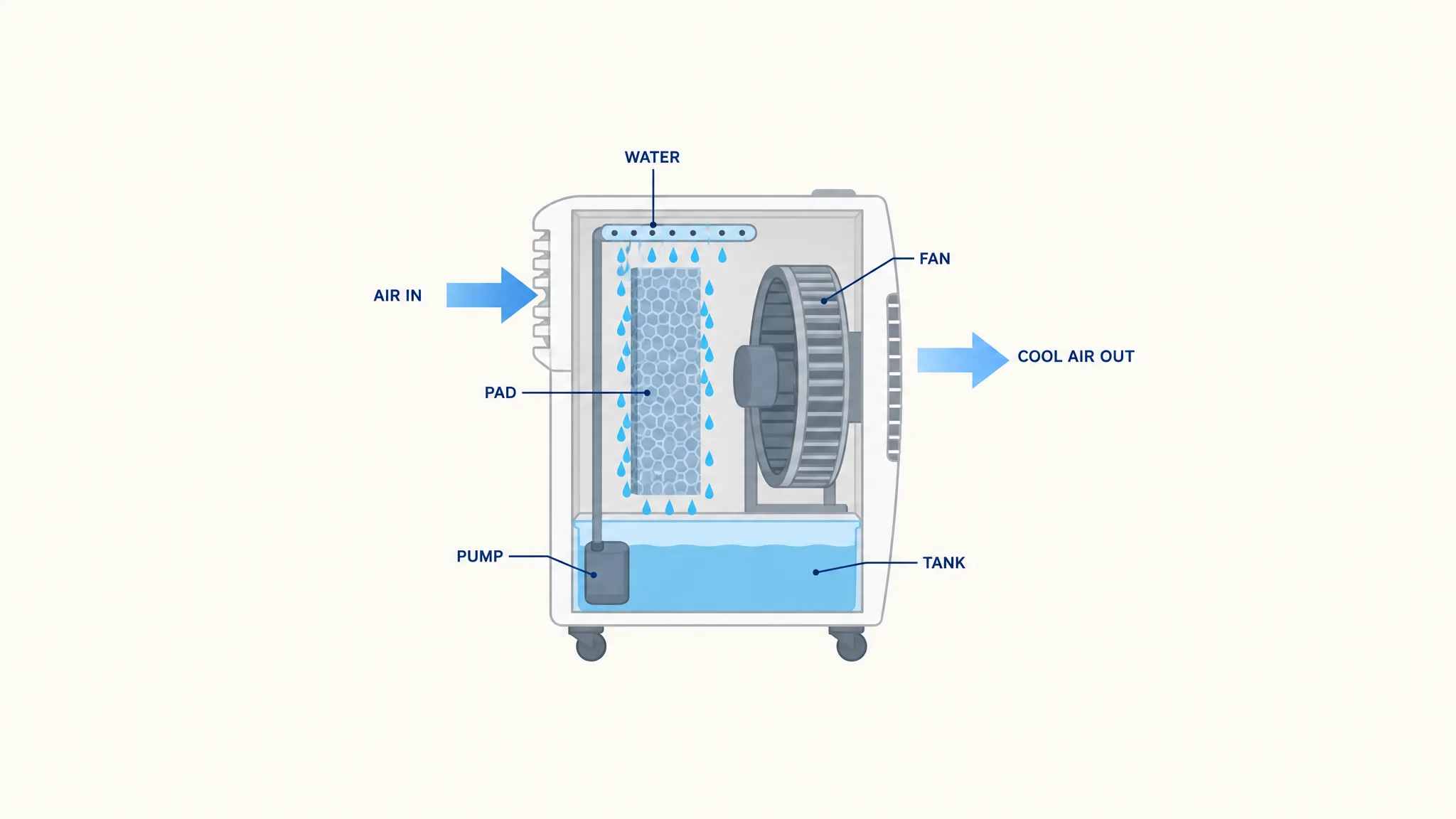
Why is my air cooler running but not cooling?
Because the cooling happens in one place only — where moving air meets water on the pad. The tank stores the water, the pump moves it, the fan brings the air, but the temperature drop itself happens on that wet surface. So when a unit runs and the room stays warm, the question is not yet which part has failed: it is whether water reached the pad at all. Air cooler problems that look electrical are often water that never arrived, or air that never passed through the water that did.
That is good news for anyone sitting in a warm room, because the first checks need no tools and no technician.
What does the water do inside the unit?
A pump lifts water from the tank to a distribution bar above the cooling pad, and the water runs down the face of the pad. The fan pulls room air in through the rear grille, through the wet pad, and pushes it out of the front. Evaporation takes heat out of the air on the way through, and that is the whole of the cooling effect — no refrigerant and no compressor.
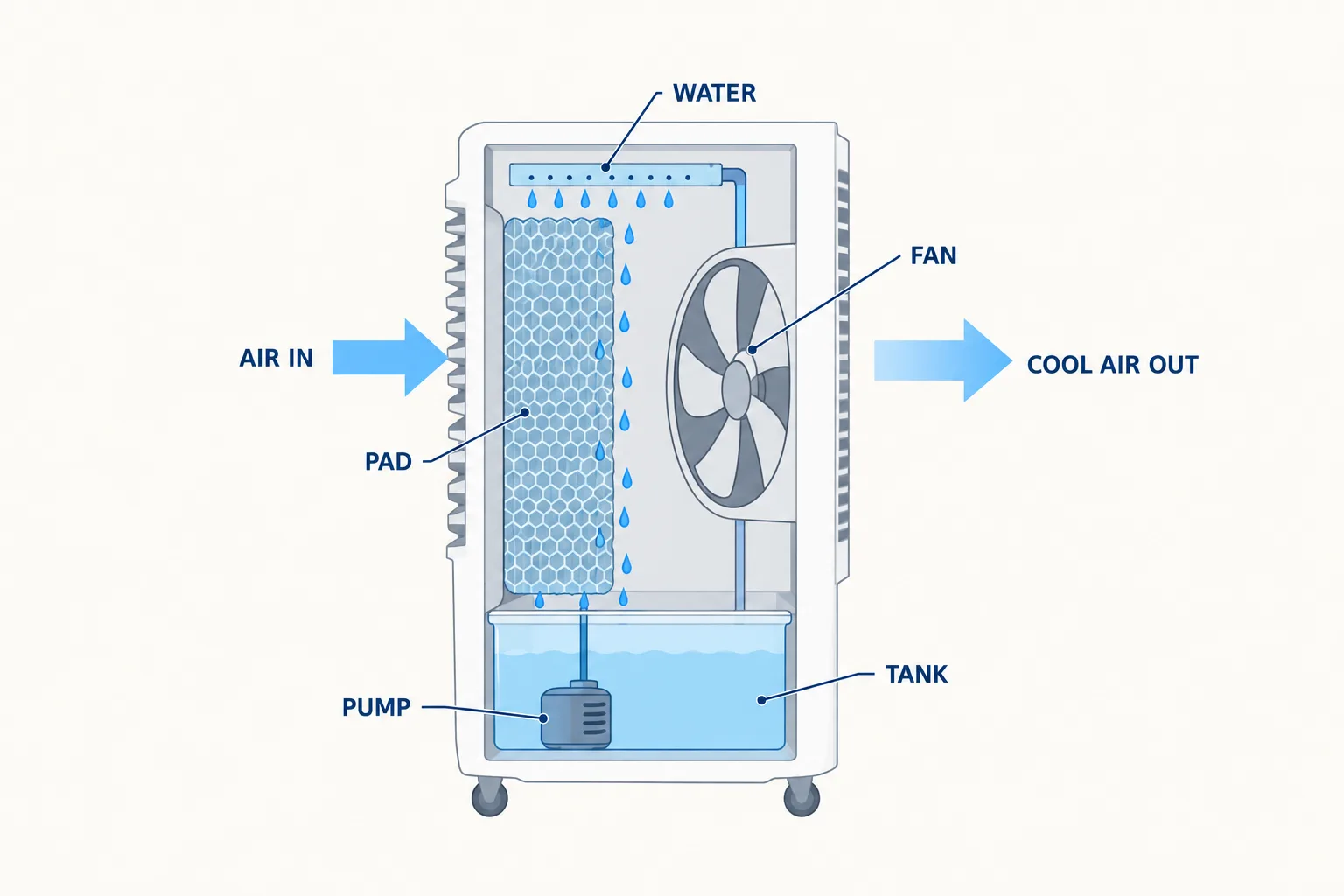
The pad has to be wet across its face. A dry patch is air that reaches the room uncooled, and a pad that is wet along the top and dry underneath is telling you the water stopped on the way down.
Which air cooler problems can I check myself?
Five, in this order: water in the tank, pad wet across its face, air moving freely, water where it should not be, and smell. Work down the list and stop at the first one that fails.
Only one of the five needs the unit to have been running. For the rest, switch it off, unplug it and let the fan come to a stop first, and watch the water level and the water flow from outside the housing — nothing below needs a panel opened.
- Water in the tank. The question is not whether there is water but whether the pump intake is under it. A tank half full can still leave the intake dry when the unit stands on a slope.
- Pad wet all over. Run the unit for a few minutes with the pump on, then switch it off and unplug it, and look at the pad through the rear grille. Wet at the top and dry lower down means water is arriving and not spreading; dry everywhere means nothing is arriving.
- Air moving freely. A dust-loaded intake screen or a scaled, torn or sagging pad chokes the air the fan can pull, and a choked pad cools whatever gets through far less.
- Water where it should not be. Check the floor, the drain, the plug and hose, and whether the tank was filled past its mark. Standing on uneven ground is enough to send water out of the wrong place. If water has reached anything electrical, stop there.
- Smell. Water left standing in the tank or held in the pad grows algae and mould, and the smell comes from there rather than from the air. Drain, clean and dry the parts, then refill with fresh water.
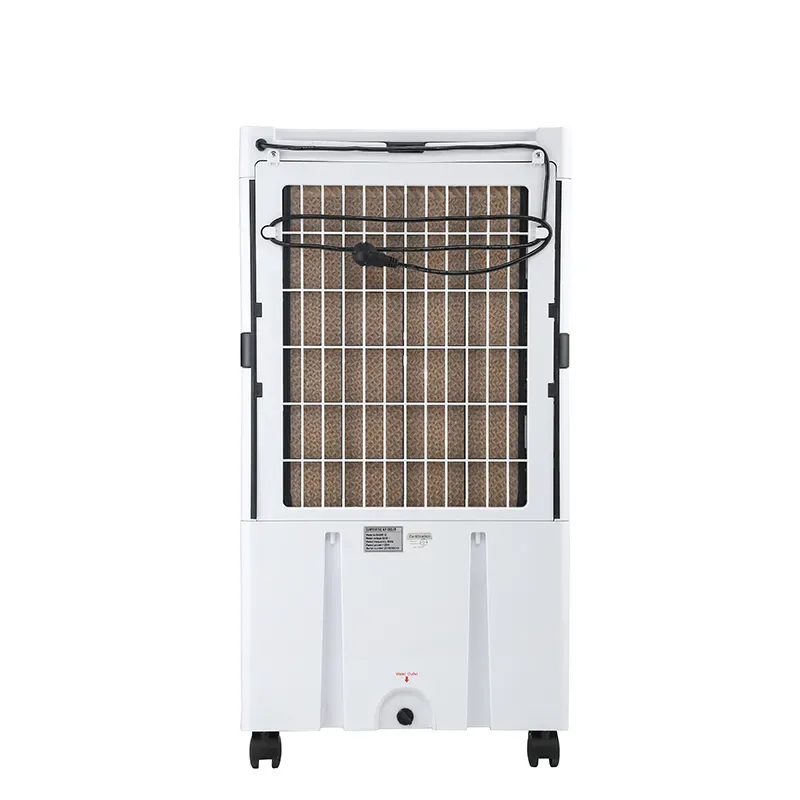
If the five come back clean and the air is still warm, the cause is often not a fault at all — the humidity section below says why.
What does a working pad look like on one of our coolers?
There is no single size. The pad scales with the unit, and a model's figure sits in its own record. These six show how far the range runs:
| Model | Water tank | Stated airflow | Cooling pad |
|---|---|---|---|
| WJD980F-3L / WJD980F-3M | 5.5 L | 980 m³/h | 30 × 210 × 265 mm |
| WJD880F-1L / WJD880F-1M | 5.5 L | 900 m³/h | 30 × 210 × 265 mm |
| WJD980F-1L | 18 L | 980 m³/h | 215 × 40 × 270 mm |
| WJD2800F-2Z | 28 L | 2,500 m³/h | 360 × 65 × 495 mm |
| WJD4500F-1D | 42 L | 4,500 m³/h | 385 × 90 × 530 mm |
| WJD8000F-1M | 80 L | 8,000 m³/h | 75 × 520 × 690 mm |
Read the airflow column against the pad and the two grow together: 30 × 210 × 265 mm on the 5.5 L coolers, 385 × 90 × 530 mm on the 42 L model, 75 × 520 × 690 mm on the 8,000 m³/h one. A smaller pad holds less water at any moment, so it dries sooner — the same water fault that leaves a 5.5 L unit blowing warm air by mid-afternoon can stay hidden for longer on a large one.
If your cooler is not one of these, ask us for its pad figure instead of matching a part by the outside of the unit.
A capacity figure that does not match the machine can send you looking for a fault that is not there. Three of our 5.5 L models — WJD980F-3L, WJD980F-3M and WJD880F-1M — were described as 6 L in older material, and that correction is recorded on this blog. If the figure on your paperwork disagrees with your model's record, treat it as a documentation problem first.
Which faults belong to a technician?
These are not maintenance tasks: a pump that hums but moves no water once its intake is clear; a fan motor that hums without turning, runs hot or smells of burning; a breaker that trips again after one reset; a damaged cord, plug or control panel; a bent blade; grinding or squealing from the motor; a cracked tank.
Each of them involves the electrical supply or a rotating part, and a unit opened without training can hurt the person opening it. Isolate the power and have a qualified person look at it before it runs again — in particular when water has reached a plug, a socket or the control panel.
Why does it cool less when the air is humid?
Because evaporation is limited by how much vapour the air can still take, and humid air takes less. The same cooler, in working order, delivers a smaller temperature drop on a humid afternoon than on a dry one. That is the air rather than the appliance, and it is the plain reason evaporative cooling suits a dry climate and struggles in a wet one.
A cooler also adds moisture to the room, so the space needs somewhere for that air to go: a window or door open on the far side, or an extract fan. In a sealed room the humidity climbs, evaporation slows, and the unit ends up moving air without cooling it.
What should I do before the unit stands unused?
Run the fan with the pump off until the pad is dry, drain the tank, clean and dry the inside, and put the unit away empty. Water left standing across a break is where the smell at the start of the next season comes from, and a pad stored damp is usually a pad that has to be replaced.
What should I send when I ask about a part?
The model code, the tank and pad figures from its record, the country the unit is used in, and a photograph of the pad, the tank and the rear grille. With those, a part is matched to the model instead of to the general shape of the unit.
Our cooler model comparison groups the models by tank and airflow, and the WJD4500F-1D record sets out one model's specifications field by field. Send the same list to our team — model, tank and pad figures, market and photographs — and we will confirm which pad and parts fit it.